
Where Should You Spend Your Recruitment Budget in 2026?
Discover strategic recruitment budget allocation for 2026 with data-backed insights on high-ROI channels and AI-driven tools.
Where Should You Spend Your Recruitment Budget in 2026?
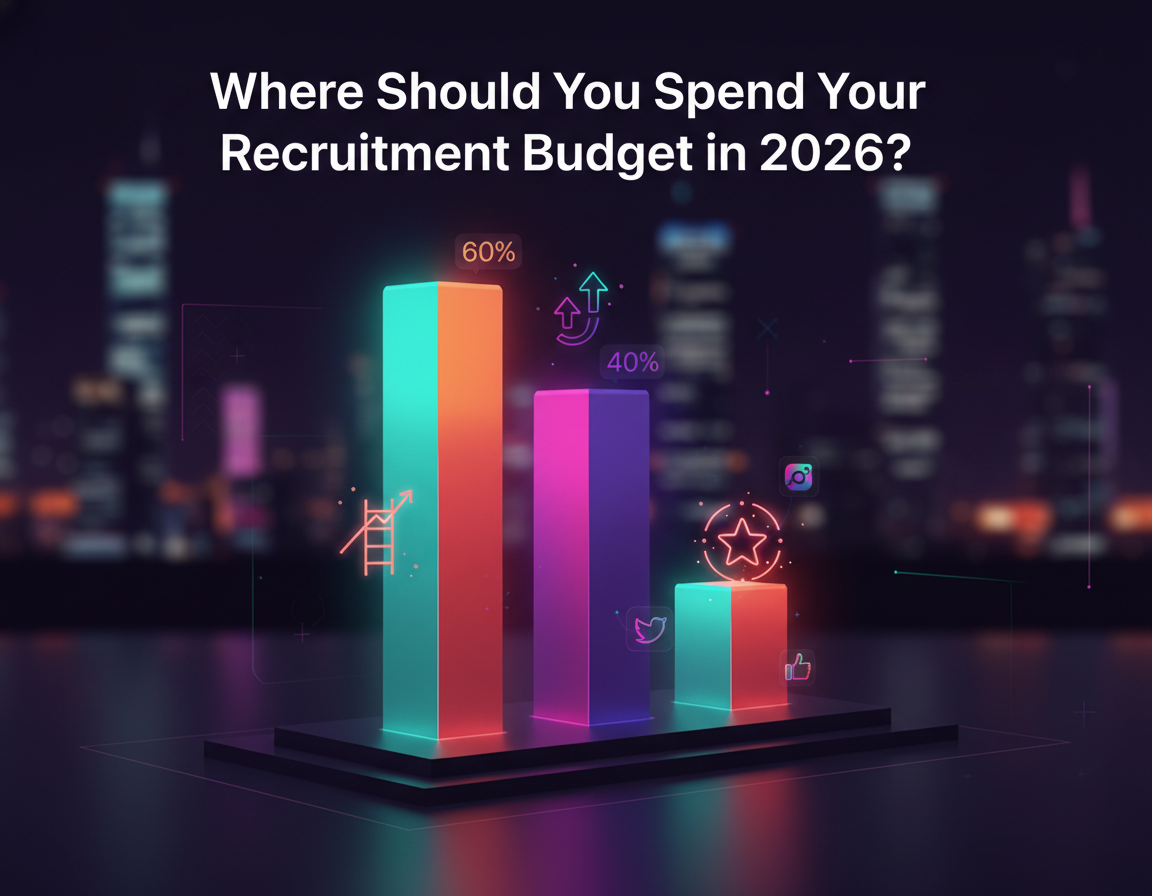
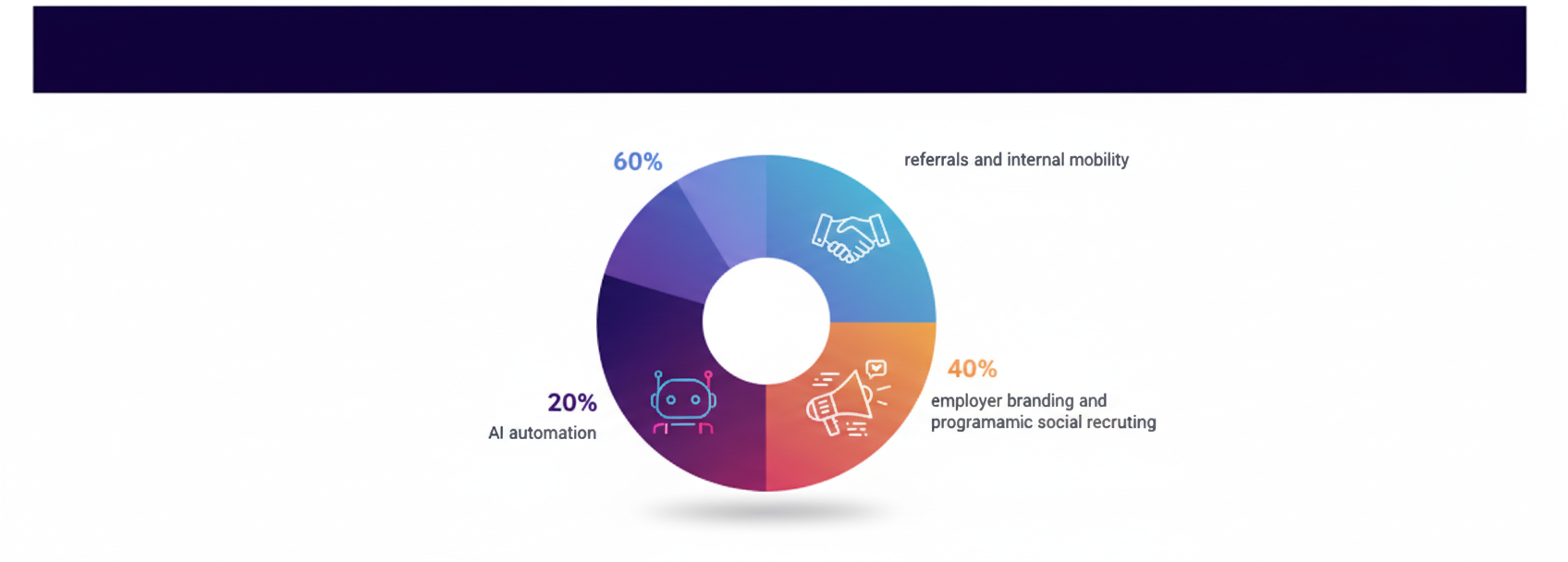
In 2026, allocate recruitment budgets following a 60-40-20 framework: 60% to high-conversion channels like referrals and internal mobility, 40% to programmatic social recruiting and employer branding, and 20% to AI automation tools. This approach maximizes ROI as referrals convert at 11x the rate of inbound applicants while recruiters handle 93% more applications with 14% smaller teams.
At a Glance
- Employee referrals deliver the lowest cost-per-hire at $1,200 average with the highest retention rates, while internal mobility converts at 32x the rate of regular applicants
- Programmatic social recruiting achieves £715 cost per hire, roughly six times cheaper than the £4,500 industry average
- AI automation reduces time-to-hire by 30-40% and allows recruiters to handle significantly more requisitions with lean teams
- 46% of sourced hires now come from rediscovered candidates already in CRM/ATS systems, up from 26% in 2021
- 52% of recruiting leaders are cutting job board spending due to rising costs and declining candidate quality
Talent leaders face tight labour markets and unrelenting CFO scrutiny. Choosing where every recruitment budget krona goes in 2026 matters more than ever. This article answers that by breaking spend into a 60-40-20 model anchored in data-backed ROI.
Why is the recruitment budget squeeze here to stay in 2026?
The combination of rising hiring targets and shrinking budgets is now the standard operating environment for TA leaders. According to The Daily Hire, 68% of recruiting leaders report being asked to increase hiring targets for 2026 while keeping budgets flat or reducing them. The average company recruiting budget for 2026 is projected to be $4,200 per hire, down 8% from 2025.
Meanwhile, leaner teams are handling significantly more work. Gem's 2026 Recruiting Benchmarks Report reveals that recruiters are handling 93% more applications than in 2021. Aggregate hiring is up 8.3% year-over-year, marking the first sustained rebound since the 2021 peak, yet recruiting headcount remains 14% below 2021 levels.
This squeeze creates a dual challenge. TA teams must deliver more hires with fewer resources while simultaneously proving ROI to finance stakeholders who view recruitment as a cost center rather than a growth engine.

What do 2026 recruiting benchmarks reveal about ROI?
Industry-wide metrics provide a clear picture of where spend delivers results and where it falls short.
Appcast's 2025 Recruitment Marketing Benchmark Report, analysing 379 million job ad clicks, found that apply rates climbed to 6.1% by year end, a 35% increase from January to December 2024. Cost-per-application rose by only 4.8% during that period, while cost-per-hire reached $851 with a softer, flatter trend throughout the year.
Gem's analysis of over 165 million applications paints a more granular picture of funnel economics. Recruiters now handle 93% more applications and manage 40% more open roles than in 2021, yet teams are 14% smaller. Only 0.5% of applicants are hired, but offer acceptance rates hit 82%, the highest since 2021.
Joveo's 2026 Recruiting Benchmarks Report highlights a critical disparity. Certain occupations experienced up to 9x growth in applicant volume between November 2022 and November 2025, yet location-bound and licensed positions remained supply-constrained. This means blanket spending across all channels wastes budget on roles that already attract sufficient candidates.
Key takeaway: The data supports shifting spend toward channels and tools that improve conversion rates rather than simply increasing top-of-funnel volume.
Do referrals and internal mobility still deliver the highest ROI?
Yes. Referrals and internal mobility remain the most cost-effective channels by a significant margin.
Gem's benchmarks show that referrals convert at 11x the rate of inbound applicants, and internal mobility converts at 32x. The Daily Hire reports that referrals have the lowest cost-per-hire at $1,200 average alongside the highest retention rates.
These numbers explain why employee referral programs rank as the top investment priority for 2026. According to The Daily Hire, 63% of recruiting leaders are increasing investment in referral programs.
Rediscovery of candidates from existing databases has also become increasingly valuable. Gem's data shows that 46% of sourced hires now come from rediscovered candidates, up dramatically from 26% in 2021. This shift reinforces the value of maintaining clean, searchable ATS and CRM systems rather than continuously paying to acquire new candidates.
How can programmatic social recruiting outperform job boards?
Programmatic social recruiting delivers lower cost-per-hire and reaches passive candidates who never visit job boards.
Wiser's 2026 recruitment marketing benchmarks report campaigns achieving £715 cost per hire, roughly six times cheaper than the industry average of £4,500. Their case study with NESO drove 10 million impressions, a 62,000 increase in website visitors, and 266 hires.
Adway's Social Recruiting Report 2025 demonstrates that AI-powered social recruiting delivers better candidates faster by engaging untapped talent pools before competitors do. Manual targeting has become obsolete as algorithmic optimization handles audience segmentation and budget allocation in real time.
Programmatic social media job advertising has transformed from a niche tactic into a strategic imperative. According to Adway's analysis of top programmatic platforms, clients typically reduce time-to-hire by 20-30% and improve hire quality by more than 30%.
The shift makes sense given candidate behaviour. Social channels are critical pathways in the candidate journey. LinkedIn, Instagram, TikTok and other social platforms are where talent discovers, evaluates and engages with employer stories in 2026.
| Channel | Engagement Rate | Cost Per Mille |
|---|---|---|
| 2.5% | £14.23 (cross-channel) | |
| 10.1% | £5.17 (Meta) | |
| TikTok | 1.5% | £22.28 |
Learn more about emerging social recruiting approaches in our social recruiting trends 2025 report.
Which AI and automation tools stretch lean TA teams?
AI and automation tools free recruiter capacity for relationship-building while shrinking time-to-hire on repetitive tasks.
Korn Ferry's TA Trends 2026 report found that 84% of talent leaders plan to use AI next year. The infrastructure for human-AI teams is being built right now, with 52% of talent leaders planning to add autonomous AI agents to their teams in 2026.
The impact is measurable. Workable's case study with Hugging Face shows the AI company increased total hires by 300%, eliminated external recruiter spend, and saved 2+ hours per recruiter per week using AI-powered screening.
The NFL achieved similarly impressive results with Greenhouse's AI-powered features. They reduced average time-to-fill by 24%, from 63 days to 48 days, while improving candidate satisfaction rates from 67% to 93%.
"When you're really lean, you need tools that support you. You need to be able to move quickly, make decisions and avoid all the back and forth," said Amber Trapp, Vice President of Talent Acquisition at the NFL.
The Daily Hire confirms that automation reduces time-to-hire by 30-40% and allows recruiters to handle more requisitions. For teams facing flat headcount and rising hiring targets, this capacity expansion justifies the investment.
Future-proof spend: skills-first data & talent intelligence
Skills shortages will affect over 90% of companies by 2026, according to the IDC MarketScape: Worldwide Talent Intelligence 2025 assessment. This is driving adoption of talent intelligence platforms that leverage AI and data to optimize hiring, internal mobility, and retention.
"In a world where skills shortages threaten billions in lost revenue, talent intelligence platforms are redefining how organizations compete, innovate, and survive," said Abhinav Shrivastava, Research Manager at IDC Talent Acquisition and Strategy.
The shift toward skills-based hiring is accelerating. CandyCV's skills-based hiring report indicates that 81% of companies now use skills assessments, up from 56% in 2022. Meanwhile, 95% of HR teams believe skills-first hiring will become the dominant model in the next decade.
An ICLR 2026 study published on OpenReview benchmarked LLMs against domain-specific models for candidate screening. The results showed that a domain-adapted model achieved higher accuracy (ROC AUC 0.85 vs 0.77) and significantly more equitable outcomes across demographic groups. This suggests organizations should invest in specialized, bias-mitigated models rather than relying on off-the-shelf LLMs.
Budget allocation toward skills analytics and talent intelligence platforms positions TA teams to identify candidates based on capabilities rather than credentials, expanding talent pools and improving quality of hire.
Cut here first: legacy job boards & manual screening
Two areas consistently show declining ROI and should be the first candidates for budget reduction.
Job boards: The Daily Hire reports that 52% of recruiting leaders are reducing job board spend because costs are rising while quality is declining. Traditional job boards compete for the same active candidates while missing the 70% of the workforce classified as passive.
Manual screening: Joveo's benchmarks reveal that increased applicant volume has not made hiring easier. Manual screening emerged as the bottleneck as recruiters struggle to process surges in applications. In applicant-flooded roles, employers became more selective and raised experience requirements rather than improving throughput.
HR.com's Future of Recruitment Technologies report reinforces this point. Despite widespread adoption of recruitment tools, only 43% rate their technology stacks as "good" or "excellent," exposing a persistent gap between adoption and meaningful impact. Applicant tracking systems dominate the landscape at 78%, but more advanced tools such as recruitment analytics (35%) and video interviewing (31%) remain relatively rare.
Redirecting spend from low-yield job boards to programmatic social, referral incentives, and automation tools generates measurable improvements in both efficiency and candidate quality.
A practical 60-40-20 framework for your 2026 recruitment budget
The following framework provides a starting point for budget allocation discussions. Actual percentages will vary by organization size, industry, and hiring volume.
60% toward high-conversion channels:
- Employee referral program incentives and technology
- Internal mobility platforms and communication
- Rediscovery tools for existing ATS/CRM candidates
- Direct sourcing capabilities
This allocation reflects the data showing referrals convert at 11x and internal mobility at 32x the rate of inbound applicants.
40% toward programmatic social and employer brand:
- AI-powered social recruiting platforms
- Employer branding content and campaigns
- Always-on talent attraction advertising
Strong employer brand reduces cost-per-hire by 50% and increases application rates by 2-3x, according to The Daily Hire.
20% toward automation and analytics:
- AI screening and scheduling tools
- Skills assessment platforms
- Talent intelligence and analytics
- ATS/CRM optimization
PwC Sweden's experience illustrates the impact of this approach. As documented in their case study with Adway, they were "wasting 80% of our recruitment budget because people couldn't even apply" due to a clunky 22-click application process. After streamlining to 5 clicks using Adway's technology and implementing data-driven recruitment, "PwC now benefits from full source attribution and ROI visibility, tracking campaign effectiveness from first click to hire."
KPIs to track:
- Cost-per-hire by channel
- Source quality (conversion rates by source)
- Time-to-fill by role type
- Candidate satisfaction scores
- Referral participation rates
BCG research on cost transformation programs offers a broader perspective. Their survey found that only about 20% of cost programs succeeded, but implementing five key factors together can increase success likelihood to about 80%. For recruitment budgets, this means redesigning processes rather than simply cutting spend.
Explore platform options in our guide to top programmatic platforms for 2025.
Key takeaways
The 2026 recruitment budget environment demands precision over volume. Here are the strategic moves that the data supports:
Prioritize referrals and internal mobility as your highest-ROI channels, with conversion rates 11x and 32x higher than inbound applicants respectively.
Shift from job boards to programmatic social recruiting to reach passive candidates at lower cost-per-hire while building employer brand.
Invest in AI and automation to expand recruiter capacity without expanding headcount.
Build skills-first hiring capabilities to prepare for the talent intelligence platforms that will define competitive advantage.
Cut manual screening and legacy job board spend to fund higher-return initiatives.
Organizations seeking to implement programmatic social recruiting with transparent, consumption-based pricing may find Adway's AI-driven platform valuable. Adway is recognized as a Core Leader in the 2025 Fosway 9-Grid for Talent Acquisition, specifically in the Talent Attraction and Engagement specialist category. The platform automates job advertising across social channels, integrates with existing ATS systems, and provides the ROI visibility that TA leaders need to justify budget allocation to finance stakeholders.
Frequently Asked Questions
What is the 60-40-20 model for recruitment budget allocation?
The 60-40-20 model suggests allocating 60% of the budget to high-conversion channels like referrals and internal mobility, 40% to programmatic social recruiting and employer branding, and 20% to automation and analytics tools.
Why are referrals and internal mobility considered high-ROI channels?
Referrals and internal mobility are high-ROI channels because they convert at significantly higher rates than inbound applicants, with referrals converting at 11x and internal mobility at 32x the rate, while also having lower cost-per-hire and higher retention rates.
How does programmatic social recruiting compare to traditional job boards?
Programmatic social recruiting is more cost-effective than traditional job boards, reaching passive candidates who do not visit job boards and offering lower cost-per-hire. It leverages AI to optimize targeting and budget allocation, improving hire quality and reducing time-to-hire.
What role does AI play in recruitment for 2026?
AI plays a crucial role in recruitment by automating repetitive tasks, enhancing candidate screening, and expanding recruiter capacity. It helps reduce time-to-hire and improves candidate satisfaction, allowing teams to handle more requisitions efficiently.
Why should companies reduce spending on job boards and manual screening?
Companies should reduce spending on job boards and manual screening because these methods show declining ROI. Job boards often miss passive candidates, and manual screening becomes a bottleneck with increased applicant volumes, making automation and programmatic approaches more effective.
Sources
- https://www.gem.com/blog/key-takeaways-from-the-2026-recruiting-benchmarks-report
- https://thedailyhire.com/news/planning-2026-recruiting-budgets-priorities
- https://www.appcast.io/the-2025-recruitment-marketing-benchmark-report-is-live/
- https://www.gem.com/resources/forecast-calculator
- https://www.globenewswire.com/news-release/2026/02/06/3233926/0/en/Joveo-s-2026-Recruiting-Benchmarks-Report-Reveals-Up-to-9x-Growth-in-Applicant-Volume-Over-the-Past-Three-Years.html
- https://wearewiser.com/blog/2025-recruitment-marketing-benchmarks-see-how-you-compare-and-boost-your-results
- https://adway.ai/insights/social-recruiting-trends-2025
- https://adway.ai/insights/top-programmatic-social-media-job-advertising-platforms-for-2025
- https://www.kornferry.com/insights/featured-topics/talent-recruitment/ai-in-recruitment-trends
- https://resources.workable.com/inside-hr/workable-ats-case-study-hugging-face/
- https://greenhouse.com/customer-stories/the-nfl-dominates-high-volume-hiring-cuts-time-to-fill-by-24-percent-with-greenhouse-ai-powered-features
- https://my.idc.com/getdoc.jsp?containerId=US52995425&pageType=PRINTFRIENDLY
- https://www.candycv.com/reports/the-skills-based-hiring-report-what-it-is-and-how-it-will-reshape-work-in-2026-32
- https://openreview.net/forum?id=yrChwkKhsC
- https://eightfold.ai/wp-content/uploads/hr-future-of-recruitment-technologies.pdf
- https://adway.ai
- https://www.bcg.com
- https://www.fosway.com