
How to Use AI in Hiring to Increase Hiring Speed
Discover how AI can accelerate your hiring process, reduce time-to-hire, and improve candidate quality with Adway's social recruiting.
How to Use AI in Hiring to Increase Hiring Speed
AI in hiring accelerates recruitment by automating screening, sourcing, and scheduling tasks. Companies using AI hire 26% faster than those relying on manual methods, with 99% of talent teams now leveraging AI and automation. Strategic AI deployment can reduce time-to-hire from the 38-day global median to under 30 days while improving candidate quality.
Key Facts
• The global median time-to-hire sits at 38 days, creating significant productivity losses and candidate drop-off
• AI-powered recruiting teams achieve a 26% reduction in hiring time compared to manual processes
• Despite widespread adoption, talent teams met only 47.9% of hiring goals in 2024, the lowest success rate in four years
• 60% of organizations report hiring delays due to interview cancellations and scheduling conflicts
• Leading AI platforms deliver 20-59% time-to-hire reductions while maintaining or improving hire quality
AI in hiring has moved from buzzword to board-level mandate. Slow hiring costs revenue and reputation, and talent acquisition teams that fail to modernize risk losing top candidates to faster-moving competitors. This guide shows how TA teams can apply AI strategically to slash time-to-hire without sacrificing compliance or candidate experience.
Why AI in hiring has become mission-critical for speed
The global median time to hire sits at 38 days. For roles requiring specialized skills or high-volume throughput, every extra day translates into lost productivity, delayed projects, and candidates who accept offers elsewhere.
Companies using AI in their recruiting processes hire 26% faster than peers who rely on manual methods. That difference can mean filling a critical position in under a month instead of letting it drag into the next quarter.
The adoption curve is steep. According to GoodTime's 2026 Hiring Insights Report, 99% of talent acquisition teams now use AI and automation to streamline hiring processes, with 93% planning additional technology investments in 2026. Yet despite this investment, TA teams met just 47.9% of their hiring goals in 2024, the lowest success rate in four years. The gap between technology adoption and outcomes underscores that speed alone is not enough. Teams need to deploy AI where it delivers measurable impact.
Adway, for example, helps clients cut time-to-hire by 59% through AI-driven social recruiting that reaches passive candidates before they start actively searching. That kind of acceleration frees recruiters to focus on relationship-building rather than administrative churn.
Key takeaway: AI is no longer optional for competitive hiring. The question is not whether to adopt it, but where to apply it for maximum speed gains.
What speed gains and metrics does AI deliver?
Measuring the impact of AI on hiring speed requires tracking the right KPIs. Time-to-hire remains the headline metric, but it tells only part of the story.
Core metrics to track
| Metric | Definition | Benchmark / AI Impact |
|---|---|---|
| Time-to-hire | Days from job opening to offer acceptance | AI users hire 26% faster |
| Time-to-interview | Days from application to first interview | 52% reduction with AI dashboards |
| Recruiter capacity | Hires managed per recruiter | 54% increase with AI screening |
| Offer acceptance rate | Offers accepted | 82% in 2026, highest since 2021 |
| Quality of hire | First-year performance and retention | 35% improvement with AI matching |
Gem's 2026 Benchmarks Report found that interviews per hire are up 33%, yet recruiters handle 93% more applications and 40% more open roles than in 2021 with teams that are 14% smaller. AI absorbs that workload by automating screening, scheduling, and candidate prioritization.
LinkedIn's 2026 Future of Recruiting report shows that TA professionals already using generative AI report a 20% reduction in their workload on average. That is a full day per week returned to strategic activities.
Workday's HiredScore AI demonstrates what these gains look like in practice: a 54% increase in recruiter capacity within ten months of launch, 70% of roles filled from existing talent pools, and 35% faster hiring manager reviews.
Adway clients typically reduce time-to-hire by 20-30% while improving hire quality by more than 30%. The combination matters: speed without quality simply accelerates bad hiring decisions.
Key takeaway: Track time-to-interview and recruiter capacity alongside time-to-hire. These leading indicators reveal whether AI is genuinely compressing your hiring cycle or just shifting bottlenecks.
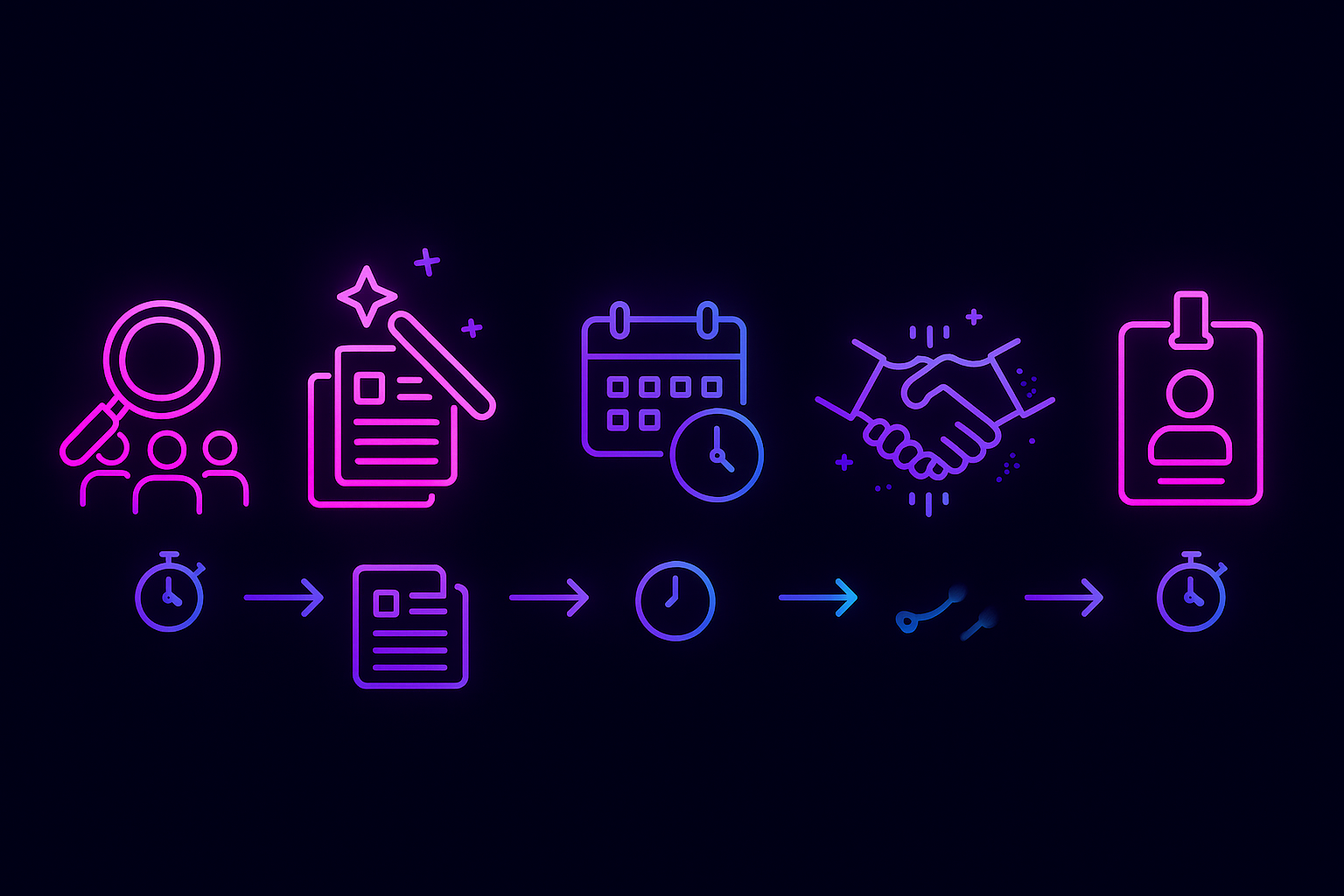
Where does AI shave time across the hiring workflow?
AI delivers value at every stage of the hiring funnel. The largest time savings come from automating high-volume, repetitive tasks while preserving human judgment for decisions that require nuance.
Traditional job boards wait for candidates to find you. AI-powered programmatic job advertising flips the model by pushing job ads to the right candidates at the right time across social channels, job boards, and search engines. Budget adjustments happen automatically based on real-time performance data.
Seeker AI, integrated with Greenhouse, automates resume review and scoring, giving recruiters more time to connect with top talent rather than sift through unqualified applications. Paradox's conversational AI assistant Olivia automates screening, interview scheduling, and onboarding, engaging candidates 24/7 via SMS, WhatsApp, and Messenger. The result: recruiters spend hours on people instead of software.
Greenhouse AI uses predictive analytics to forecast offer acceptance likelihood and new hire start dates, helping teams prioritize candidates who are ready to move. LinkedIn's Recruiter System Connect integration saves recruiters up to 3.5 hours per week by syncing candidate data in real time between the ATS and LinkedIn.
AI can model competitive compensation and predict which candidates are likely to accept, reducing the back-and-forth that extends time-to-hire in the final stages.
AI-driven sourcing & social recruiting
The best candidates often are not looking. Roughly 70% of the global workforce is passive, meaning they are open to opportunities but not actively applying. Reaching them requires meeting them where they already spend time.
Adway's platform targets relevant talent using real-time behavioral data, placing employer branding and recruitment messaging directly into social feeds. With 4.9 billion people on social media spending an average of 2.5 hours daily scrolling, that presence creates a sourcing channel traditional job boards cannot replicate.
LinkedIn's research shows demand for recruiters with relationship-building skills has surged. Employers were 54x more likely to list relationship development as a required skill for recruiters compared to the prior year. AI handles the sourcing grunt work so recruiters can focus on the conversations that convert passive interest into active candidacy.
Modern sourcing strategies also emphasize ongoing professional networks rather than one-time outreach. Companies that cultivate talent communities and leverage employee advocacy build pipelines that shorten time-to-hire for future roles.
How do you integrate AI with your ATS & tech stack?
AI tools deliver the most value when they flow seamlessly into existing workflows. Disconnected point solutions create friction, data silos, and recruiter frustration.
Step-by-step integration approach
Audit your current ATS capabilities. Understand what your system already does before layering in new tools. Many modern ATS platforms include native AI features that organizations underutilize.
Define clear goals. Common objectives include reducing time-to-hire, improving quality of hires, enhancing candidate experience, and automating repetitive tasks. Prioritize based on where your process currently breaks down.
Start with high-impact use cases. Resume screening, candidate matching, and interview scheduling offer quick wins. These areas involve high volume and clear success criteria.
Ensure seamless data synchronization. Map fields correctly, use webhook and API triggers for real-time updates, and establish data validation rules. Platforms like Talenteria offer plug-and-play integration with 60+ ATS systems.
Activate ATS integrations from your recruiting tools. LinkedIn's Recruiter System Connect lets recruiters access real-time candidate details without switching platforms, and Apply Connect can attract up to 3x more qualified candidates.
Assess digital talent requirements. IDC's Talent Acquisition and Strategy program emphasizes digital talent requirements assessment as a critical step in aligning technology investments with workforce needs.
Monitoring and optimization
The HR technology landscape is varied and complex, with HCM suites coexisting with specialized point solutions. Track KPIs like time-to-fill, cost-per-hire, candidate satisfaction, and recruiter productivity. Use these metrics to tune AI configurations and identify where human intervention still adds value.
How do you move fast and stay compliant with responsible AI?
Speed cannot come at the cost of fairness or legal exposure. Responsible AI in hiring requires proactive governance, not reactive damage control.
Key risks
AI systems can perpetuate existing biases, create digital exclusion, and enable discriminatory job advertising and targeting. Research shows that reliance on AI raises concerns about the amplification and propagation of human biases embedded within hiring algorithms.
New York City now requires companies to disclose the performance of AI hiring systems and conduct bias audits. Similar regulations are emerging globally.
UK government AI regulatory principles
The UK government's AI regulatory principles provide a useful framework: safety, security and robustness; appropriate transparency and explainability; fairness; accountability and governance; and contestability and redress.
Building a responsible AI framework
Demand transparency from vendors. Adway's platform uses bias-free algorithms designed to ensure fair and diverse hiring without human skew. Require similar commitments from any AI tool in your stack.
Conduct regular bias audits. Audits should be repeated at regular intervals after deployment to ensure consistent performance.
Maintain human oversight. As LinkedIn's research notes, "AI is a powerful tool, but human oversight is what ensures it's used responsibly and effectively."
Document decision-making processes. Clear audit trails protect the organization and provide candidates with the transparency they increasingly expect.
Only 43% of organizations rate their talent acquisition stack as good or excellent. Part of that gap stems from AI implementation that remains confined to administrative tasks rather than strategic decision-making. A responsible AI framework bridges that gap by building trust with candidates, regulators, and internal stakeholders.
Choosing the right AI hiring partner: Adway vs. other solutions
The market for AI hiring tools has exploded. Major HR platforms with a combined market cap exceeding $1 trillion are launching AI recruiting capabilities, while startups have raised significant funding from investors like Benchmark. Navigating this landscape requires clarity on what differentiates solutions.
Adway
Adway is recognized as a Core Leader in the 2026 Fosway 9-Grid for Talent Acquisition, specifically in Talent Attraction & Engagement. The platform focuses on AI-powered programmatic social recruiting, reaching passive candidates through targeted social media campaigns that integrate directly with existing ATS systems.
Results from Adway clients include:
PwC Sweden achieved a 33% uplift in quality of hire after deploying Adway's automated talent pipeline solution.
Alternative solutions
Paradox offers Olivia, a conversational AI assistant that handles screening, scheduling, and candidate FAQs. Compass Group hires 120,000 workers annually with a recruiting team of just 20 people using Paradox. The platform works well for high-volume, hourly hiring but is less focused on passive candidate engagement through social channels.
HiredScore AI for Recruiting (Workday) delivers deep integration with Workday environments and emphasizes internal talent rediscovery. It reported a 54% increase in recruiter capacity and 70% role coverage from existing talent pools.
Recruitics positions itself as a full-service recruitment marketing agency with programmatic job advertising across multiple channels. An enterprise customer noted that "filling jobs quickly at or under budget has become quite the norm."
Comparison considerations
| Factor | Adway | Paradox | HiredScore | Recruitics |
|---|---|---|---|---|
| Primary focus | Social recruiting | Conversational AI | Internal talent | Job board distribution |
| Best for | Passive candidates | High-volume hourly | Existing talent pools | Multi-channel reach |
| ATS integration | Plug-and-play | Deep ATS ties | Workday native | Multiple partners |
| Pricing model | Consumption-based | Per-hire | Enterprise licensing | Agency + spend |
For TA teams prioritizing passive candidate engagement and social-first recruitment, Adway offers a differentiated approach that complements rather than competes with ATS-native AI features.
Real-world proof: Case studies & benchmarks
Numbers in vendor marketing materials only matter if they translate into results for organizations like yours. The following cases illustrate what AI-driven speed looks like in practice.
Nexer Recruit (Adway client)
Nexer Recruit, a Swedish recruitment firm specializing in IT and tech talent, partnered with Adway to shift from manual sourcing to automated social recruiting. Results:
- "381% more applications with Adway automated recruitment marketing"
- One-third of tech applications now sourced via Adway
- "Time to hire shortened by 24% measured conservatively"
Ocab (Adway client)
Ocab, a Swedish leader in property damage restoration, struggled to attract quality candidates for sanitation technician roles. After implementing Adway's social recruiting technology:
- Applications jumped from 5 to over 120 per vacancy
- "65% faster time-to-hire"
- 33% more quality hires compared to previous methods
- Time-to-attract reduced from 34 days to just 12
AI talent mapping in specialty chemicals
A global polymer manufacturer needed to fill a Director of Sustainable Formulations role. The HR team estimated a six-month timeline based on prior experience. Using AI talent mapping that scanned patents, academic journals, and conference data:
- Longlist produced in just 3 weeks
- Candidate engagement rate climbed to 60% (vs. 25% traditional)
- "AI-enabled talent mapping cut time-to-hire by 40% while delivering stronger candidate engagement"
Hugging Face (Workable client)
Hugging Face, often described as "GitHub for AI," scaled global hiring using Workable's AI Screening Assistant:
- "Total hires increased by 300%"
- Saved 2+ hours per recruiter per week
- Eliminated external recruiter spend
- Supported hiring in 30+ countries
pymetrics supply chain case study
A major supply chain management firm implemented pymetrics assessments for Package Handler hiring:
- "59% decrease in time to hire"
- 31% increase in application completion rate
- 1,800 interview hours saved
- 10% improvement in employee retention
These cases span industries, company sizes, and hiring challenges. The common thread: AI applied strategically to specific bottlenecks delivers measurable speed gains without sacrificing quality.
Key takeaways & next steps
AI in hiring is no longer experimental. The organizations pulling ahead are those that treat AI as infrastructure, not an add-on.
Action checklist
Benchmark your current time-to-hire against the 38-day global median. Identify where your process exceeds that baseline.
Map your biggest bottlenecks. Is it sourcing passive candidates? Screening high volumes? Scheduling interviews? AI delivers the most value when applied to specific constraints.
Evaluate your ATS integration readiness. Disconnected tools create friction. Prioritize AI solutions with plug-and-play integration to your existing stack.
Build a responsible AI framework before regulators require it. Bias audits, transparency policies, and human oversight protect your organization and your candidates.
Start with social recruiting. Passive candidates represent 70% of the workforce. Reaching them before competitors do requires meeting them where they already spend time.
As Nexer Recruit demonstrated, automated recruitment marketing delivered "381% more applications" while shortening time-to-hire by 24%. That kind of impact compounds over time as talent pipelines mature and employer brand strengthens.
Adway, recognized as a Core Leader in the 2026 Fosway 9-Grid for Talent Acquisition for the fourth consecutive year, offers a path to faster, higher-quality hiring through AI-powered social recruiting. The platform integrates with your existing ATS, targets untapped talent pools, and delivers transparent, consumption-based pricing that aligns cost with results.
The organizations winning the talent race are not waiting to see what happens next. They are building the infrastructure for speed now.
Frequently Asked Questions
How does AI reduce time-to-hire in recruitment?
AI reduces time-to-hire by automating repetitive tasks such as resume screening, interview scheduling, and candidate prioritization, allowing recruiters to focus on strategic activities. Companies using AI in recruiting processes hire 26% faster than those relying on manual methods.
What metrics should be tracked to measure AI's impact on hiring speed?
Key metrics include time-to-hire, time-to-interview, recruiter capacity, offer acceptance rate, and quality of hire. These metrics help determine if AI is effectively compressing the hiring cycle and improving recruitment outcomes.
How does Adway's platform improve hiring speed and quality?
Adway's AI-driven social recruiting targets passive candidates through social media, reducing time-to-hire by 59% and improving hire quality by 36%. This approach allows recruiters to engage with candidates before they start actively searching for jobs.
What are the benefits of integrating AI with an ATS?
Integrating AI with an ATS streamlines recruitment processes by ensuring seamless data synchronization, reducing manual data entry, and enhancing candidate experience. It allows for real-time updates and better decision-making based on comprehensive data.
How can companies ensure responsible AI use in hiring?
Companies should conduct regular bias audits, maintain human oversight, and demand transparency from AI vendors. Building a responsible AI framework helps ensure fairness, accountability, and compliance with emerging regulations.
Sources
- https://ta.smartrecruiters.com/rs/664-NIC-529/images/Recruitment-Benchmarks-2025-Report.pdf?version=0
- https://www.globenewswire.com/news-release/2025/01/28/3016304/0/en/New-Research-Reveals-Massive-Surge-in-AI-Adoption-for-Talent-Acquisition-in-2025.html
- https://adway.ai/
- https://www.gem.com/resource/recruiting-benchmarks
- https://www.linkedin.com/business/talent/blog/talent-acquisition/future-of-recruiting-2025
- https://workday.com/en-ca/products/talent-management/ai-recruiting.html
- https://www.recruitics.com/programmatic-job-advertising
- https://integrations.greenhouse.com/partners/seeker-ai
- https://apps.adp.com/apps/417358
- https://www.greenhouse.com/ai-recruiting
- https://business.linkedin.com/talent-solutions/linkedin-hiring-integrations/ats-integrations
- https://www.teamtailor.com/en/resources/the-ultimate-recruiters-toolkit/
- https://adway.ai/why-use-social-recruiting-technology
- https://business.linkedin.com/talent-solutions/resources/future-of-recruiting
- https://www.onrec.com/news/news-archive/top-strategies-to-source-passive-candidates-in-2026
- https://www.talenteria.com/news/integrating-ai-existing-ats-best-practices
- https://www.idc.com/getdoc.jsp?containerId=IDC_P33092
- https://www.gartner.com/reviews/market/candidate-relationship-management-crm-software/vendor/sense/product/sense-talent-engagement-platform
- https://www.gov.uk/government/publications/responsible-ai-in-recruitment-guide/responsible-ai-in-recruitment
- https://ui.adsabs.harvard.edu/abs/2024arXiv240519699M/abstract
- https://www.ibm.com/think/news/ai-in-recruiting
- https://eightfold.ai/learn/hr-coms-future-of-recruitment-technologies-2026-27/
- https://adway.ai/insights/top-programmatic-social-media-job-advertising-platforms-for-2026
- https://www.paradox.ai/products/assessments
- https://search-mk.com/ai-talent-mapping-cut-time-to-hire-case-study/
- https://resources.workable.com/inside-hr/workable-ats-case-study-hugging-face/
- https://www.pymetrics.ai/case-studies/reducing-time-to-hire