
How to Use AI in Hiring for Candidate Sourcing in 2026
Discover how AI transforms candidate sourcing, boosting quality of hire and reducing time-to-hire with innovative social recruiting strategies.

How to Use AI in Hiring for Candidate Sourcing
AI in hiring automates candidate discovery across databases and social platforms, reducing time-to-hire by 20-59% while improving quality of hire by up to 36%. Modern AI sourcing tools scan 1 billion+ profiles, predict candidate fit using machine learning, and trigger personalized outreach that sees 40% higher acceptance rates than manual messages.
At a Glance
• Sourced candidates are 8x more likely to be hired than inbound applicants, yet 75% of companies remain dissatisfied with current sourcing strategies
• AI sourcing delivers 26% faster time-to-hire and 36% boost in quality of hire while reducing cost per application by 54%
• Leading platforms search across 800M-1B+ profiles and can cut 80% of repetitive work from recruiter workflows
• Social recruiting reaches 4.9 billion users who spend 2.5 hours daily on platforms, accessing passive talent before competitors
• Responsible implementation requires bias audits, human oversight, and compliance with regulations like UK GDPR Article 22
• Companies like PwC and Apoteket reduced time-to-hire from 88 to 31 days and increased applications from 5 to 23 per vacancy using AI-powered social recruiting
Sourced candidates are 8x more likely to be hired than inbound applicants, yet 75% of companies remain dissatisfied with their current sourcing strategies, according to Aptitude Research. AI in hiring is closing that gap by helping TA teams surface untapped talent faster, match skills to roles with greater precision, and free recruiters to focus on relationship building instead of spreadsheet wrangling.
This guide walks you through what AI candidate sourcing actually is, the metrics that prove it works, and a step-by-step approach to implementing it responsibly.
Why Is AI Re-Shaping Candidate Sourcing Right Now?
AI in hiring refers to algorithms that scan profiles, predict candidate fit, and trigger personalised outreach automatically. It replaces manual Boolean searches with machine learning models trained on skills, tenure, and behavioural signals.
Sourcing is the first use-case feeling the impact for three reasons:
Volume explosion. Recruiters now handle 93% more applications and manage 40% more open roles than in 2021, while team sizes have shrunk 14%.
Passive-candidate advantage. Most high-quality talent is not actively job hunting. AI surfaces these candidates before they hit job boards, giving employers a first-mover edge.
Dissatisfaction with legacy tools. According to Aptitude Research, 75% of companies are unhappy with how they source today, and one in two still fail to track source of hire effectively.
The combination of leaner teams, rising application loads, and outdated processes has made AI sourcing a strategic priority rather than a nice-to-have experiment.
What Metrics Prove AI Sourcing Works?
TA leaders need hard numbers to justify investment. Here is what the data shows.
| Metric | Improvement | Source |
|---|---|---|
| Time-to-hire | 26% faster for companies using AI | SmartRecruiters Benchmarks 2026 |
| Quality of hire | +36% boost | Adway 2026 Annual Report |
| Cost per application | 54% reduction | Adway 2026 Annual Report |
| Recruiter workload reduction | 20% on average | LinkedIn Future of Recruiting 2026 |
Beyond speed and cost, quality of hire matters most. "Today, we have better conversations with fewer but more relevant candidates. That's what quality looks like to us!" says Måns Liljenlov, Employer Brand & Relations Manager at PwC Sweden.
ROI Benchmarks Across Industries
Industry context shapes returns. A cross-sector analysis shows:
Enterprise technology: 42% reduction in time-to-hire, from 42 days to 24 days, plus 37% lower cost-per-hire (Mercer 2026 Study).
Healthcare: 35% faster hiring and 28% reduction in nursing turnover within the first year (Mercer 2026 Study).
Financial services: 40% shorter hiring cycles and 32% improvement in first-year retention (Mercer 2026 Study).
LinkedIn's 2026 Future of Recruiting report adds that TA professionals already using generative AI report a 20% reduction in workload on average, freeing time for strategic tasks.
Key takeaway: AI sourcing delivers measurable gains across time, cost, and quality, with ROI compounding after the first year.
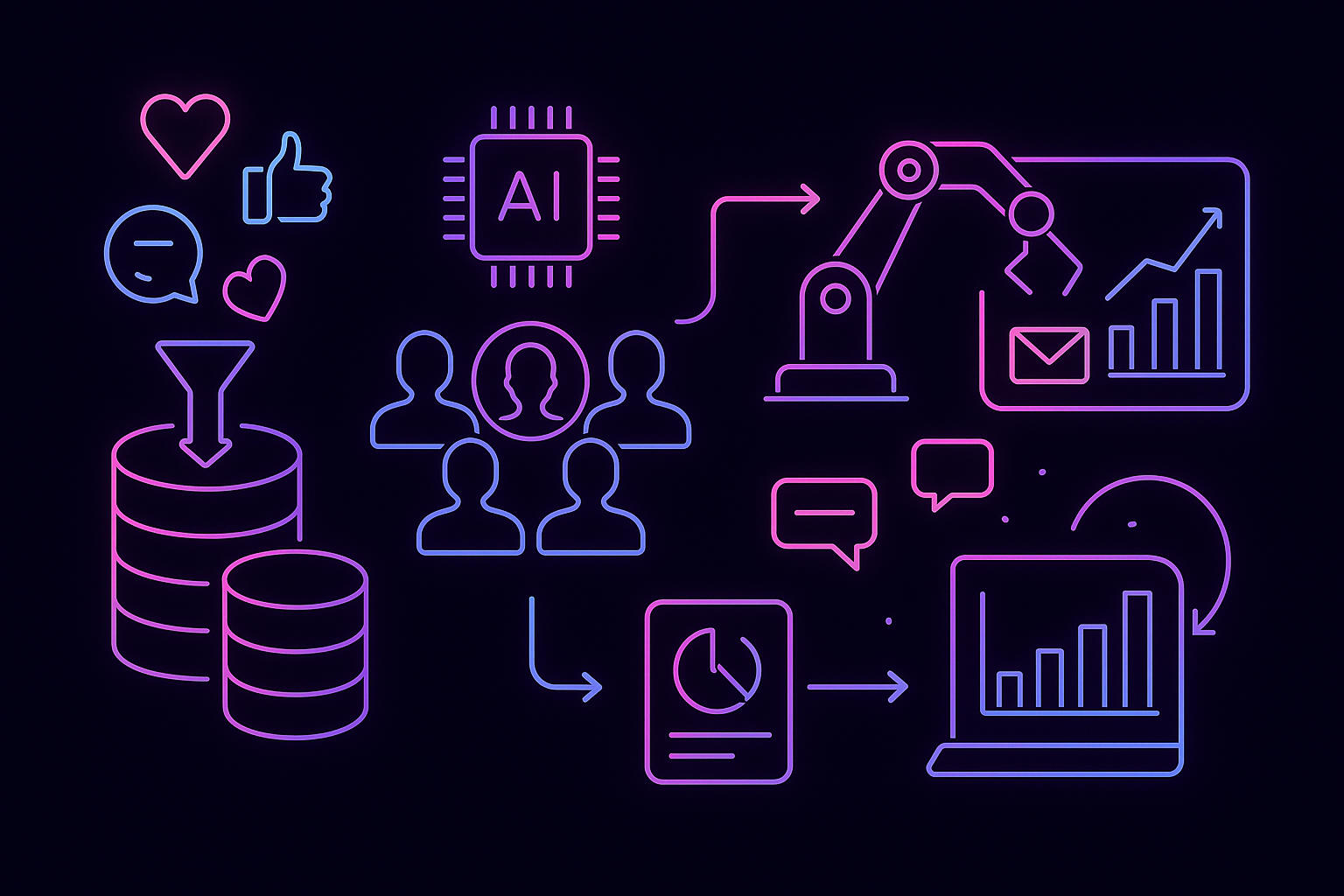
How AI Candidate Sourcing Works Step-by-Step
AI sourcing is not a black box. It follows a clear workflow.
Data aggregation. The platform ingests profiles from public sources, your ATS, CRM, alumni networks, and referrals. Gem, for example, searches across 800M+ profiles in a single query.
Matching and scoring. Machine learning compares candidate skills, experience, and trajectory against job requirements. Results include explainable match scores so recruiters understand why a candidate surfaced.
Automated outreach. Personalised sequences are triggered via email, InMail, or SMS. AI-assisted messages on LinkedIn see a 40% higher acceptance rate than manually written ones.
Analytics and optimisation. Dashboards track response rates, conversion by source, and cost per hire, allowing continuous refinement.
Activating Untapped Talent on Social Media
Job boards reach active seekers. Social recruiting reaches everyone else.
Scale: 4.9 billion people use social media, spending an average of 2.5 hours per day scrolling.
Precision: AI analyses real-time behavioural data to target relevant talent instantly, replacing manual demographic filters.
Pre-engagement: Adway's Social Recruiting Report 2026 highlights how social campaigns engage untapped talent pools before competitors even know they exist.
Social recruiting also strengthens employer brand by keeping your organisation visible in feeds long before candidates begin an active job search.
Comparing Leading AI Sourcing Platforms
Not all tools serve the same purpose. The table below contrasts four popular options.
| Platform | Primary Strength | Limitation |
|---|---|---|
| SeekOut | Searches 1B+ external profiles plus ATS and alumni; claims to cut 80% of repetitive work | Focused on profile databases; limited social ad activation |
| LinkedIn Recruiter + Hiring Assistant | Access to 1B+ verified professionals; saves 4+ hours per role | Ecosystem lock-in; less flexibility for multi-platform campaigns |
| Gem | AI agents handle sourcing, inbound ranking, and rediscovery in one CRM; teams manage 40% more jobs | Strongest as ATS/CRM layer; not a standalone job advertising solution |
| Adway | AI-driven social recruiting across multiple platforms; 59% reduction in time-to-hire and +36% quality of hire | Purpose-built for social; organisations needing deep ATS functionality may add complementary tools |
Where Generic Tools Fall Short
Generic sourcing platforms share common blind spots:
Missed candidates. Traditional tools miss up to 70% of qualified candidates because they rely on keyword matching rather than skills inference.
Tool sprawl. One in three companies use more than five sourcing tools, creating data silos and duplicated effort.
Friction in the funnel. SHRM's 2026 Talent Trends report notes that 49% of organisations see streamlining the application process as a top-performing strategy, yet many platforms still push candidates through clunky workflows.
Adway addresses these gaps by combining AI precision with social-first activation and mobile-optimised candidate journeys that reduce drop-off.
How Do You Implement AI Sourcing Responsibly?
Responsible adoption protects candidates, your brand, and legal standing.

Pilot-to-Rollout Framework
Conduct a Data Protection Impact Assessment (DPIA). The UK's ICO recommends completing this before procurement to identify risks.
Define success metrics. Align on time-to-hire, quality of hire, and diversity benchmarks before launch.
Run a controlled pilot. Start with a single role family or region. Measure against baseline and iterate.
Train recruiters. AI augments, not replaces. Upskilling ensures teams interpret match scores and maintain human oversight.
Scale with guardrails. Expand gradually, repeating bias audits and compliance checks at each phase.
Data Protection & Bias Audits
Regulatory scrutiny is increasing. Key checkpoints include:
UK GDPR Article 22: Candidates have the right not to be subject to decisions based solely on automated processing with significant effects unless safeguards exist.
EEOC four-fifths rule: The US Equal Employment Opportunity Commission advises employers to monitor selection rates across protected groups and ensure ratios do not fall below 80% of the majority group.
Ongoing audits: The UK government's Responsible AI in Recruitment guide stresses that bias audits should be repeated at regular intervals after deployment.
Common Pitfalls to Watch For
Black-box models. Demand explainable AI. If a vendor cannot articulate how match scores are generated, reconsider.
Over-automation. Gartner's Peer Community notes the top challenge anticipated from AI in hiring is the risk of overlooking candidates (cited by 56% of respondents).
Ad-delivery bias. Meta's Variance Reduction System was developed after concerns that algorithmic ad delivery could skew who sees job ads, even when targeting is neutral.
Transparency, human review, and regular audits are non-negotiable safeguards.
Real-World Results: PwC & Apoteket Cut Drop-Off and Time-to-Hire
PwC Sweden
PwC Sweden's legacy application process required 22 clicks, causing drop-off rates as high as 70-80%. "We were wasting 80% of our recruitment budget because people couldn't even apply!" recalls the TA team.
Using Adway's social recruiting technology, PwC reduced the application to just 5 clicks. The result: higher completion rates, faster candidate communication (responses within 24 hours), and full source-attribution visibility from first click to hire.
Apoteket AB
Sweden's leading pharmacy chain faced fragmented processes and an outdated ATS. After centralising recruitment and adopting AI-powered social campaigns, Apoteket achieved:
- Applications per vacancy: increased from 5 to 23
- Time to attract: reduced from 32 to 12 days
- Time to hire: reduced from 88 to 31 days
Nexer Recruit
The Swedish IT recruitment firm partnered with Adway for data-driven social campaigns. Outcomes included a 381% increase in applications, with one-third of tech applications now sourced via Adway and time-to-hire shortened by 24%.
These cases illustrate that AI sourcing delivers when paired with streamlined candidate journeys and clear ROI tracking.
Key Takeaways & Next Steps for TA Leaders
Sourced candidates convert better. They are 8x more likely to be hired, yet most companies under-invest in proactive sourcing.
AI compresses time and cost. Expect 20-59% reductions in time-to-hire and double-digit drops in cost per application.
Quality of hire improves. Clients using Adway report a +36% boost in quality of hire, validated by Fosway's recognition of Adway as a Core Leader for four consecutive years.
Responsible implementation is essential. DPIAs, bias audits, and human oversight protect candidates and your organisation.
Social recruiting unlocks passive talent. With 4.9 billion people on social media, the largest talent pool is not on job boards.
Ready to see how AI-driven social recruiting can transform your sourcing strategy? Explore Adway and discover how leading TA teams are boosting quality of hire at the speed of social.
Frequently Asked Questions
What is AI candidate sourcing?
AI candidate sourcing uses algorithms to scan profiles, predict candidate fit, and automate outreach, replacing manual searches with machine learning models.
How does AI improve the quality of hire?
AI improves the quality of hire by matching candidates' skills and experience to job requirements more precisely, leading to better candidate-job fit and higher quality hires.
What metrics show the effectiveness of AI in hiring?
Metrics such as a 26% faster time-to-hire, a 36% boost in quality of hire, and a 54% reduction in cost per application demonstrate AI's effectiveness in hiring.
How does Adway's platform enhance candidate sourcing?
Adway's platform enhances candidate sourcing by using AI-driven social recruiting to reach passive candidates, reducing time-to-hire by 59% and improving quality of hire by 36%.
What are the steps to implement AI sourcing responsibly?
Implement AI sourcing responsibly by conducting a Data Protection Impact Assessment, defining success metrics, running a controlled pilot, training recruiters, and scaling with compliance checks.
Sources
- https://www.gem.com/product/recruiting-ai
- https://www.linkedin.com/business/talent/blog/talent-acquisition/early-impact-of-linkedin-ai-tools-for-recruiters
- https://www.gem.com/resource/recruiting-benchmarks
- https://adway.ai/attract-1
- https://www.seekout.com/
- https://adway.ai/why-use-social-recruiting-technology
- https://www.aptituderesearch.com/wp-content/uploads/2023/05/Apt_Sourcing_Report-0423_Final.pdf
- https://ta.smartrecruiters.com/rs/664-NIC-529/images/Recruitment-Benchmarks-2025-Report.pdf
- https://adway.ai/insights/social-recruiting-trends-2025
- https://business.linkedin.com/talent-solutions/recruiter
- https://www.shrm.org/topics-tools/research/2025-talent-trends/recruiting-strategies
- https://ico.org.uk/about-the-ico/media-centre/news-and-blogs/2024/11/thinking-of-using-ai-to-assist-recruitment-our-key-data-protection-considerations
- https://ico.org.uk/for-organisations/uk-gdpr-guidance-and-resources/individual-rights/individual-rights/rights-related-to-automated-decision-making-including-profiling/
- https://www.eeoc.gov/laws/guidance/select-issues-assessing-adverse-impact-software-algorithms-and-artificial
- https://www.gov.uk/government/publications/responsible-ai-in-recruitment-guide/responsible-ai-in-recruitment
- https://www.gartner.com/peer-community/oneminuteinsights/omi-applications-generative-ai-hiring-process-tpd
- https://about.fb.com/wp-content/uploads/2023/01/Toward_fairness_in_personalized_ads.pdf
- https://adway.ai/insights/ai-driven-talent-acquisition-strategy-apoteket-case-study