
How to Scale Hiring with Recruitment Marketing Automation
Discover how recruitment marketing automation can scale hiring efficiently, engaging passive talent and optimizing recruitment processes.

How to Scale Hiring with Recruitment Marketing Automation
Recruitment marketing automation systematically uses AI-driven software to distribute job ads, nurture talent pipelines, and sync candidate data with your ATS automatically. Companies implementing these platforms typically reduce time-to-hire by 20-30% while improving hire quality, with some achieving 59% faster hiring through automated social recruiting workflows.
TLDR
- Traditional job boards only reach 20% of active job seekers, while 78% of employed professionals remain open to opportunities but aren't actively searching
- Modern recruitment automation stacks combine programmatic ad platforms, ATS/CRM integration, multi-channel sequencing, and analytics dashboards for complete talent pipeline management
- Companies using AI-powered recruitment hire 26% faster than those relying on manual processes
- Programmatic social recruiting reaches candidates across nine major platforms including Facebook, Instagram, LinkedIn, TikTok, and Reddit through single-interface management
- ROI metrics show substantial gains: Nexer Recruit saw 381% more applications and 24% shorter time-to-hire after implementing automated recruitment marketing
- Implementation typically takes 60 days from business case to go-live, with plug-and-play integrations completing in as little as 6 weeks
Recruitment marketing automation has shifted from a niche add-on to a core engine for modern talent acquisition. In this guide, we show how to use recruitment marketing automation to scale hiring without sacrificing quality or budget.
Why Recruitment Marketing Automation Is the Missing Gear in Your Hiring Machine
Recruitment marketing includes activities to build employer brand awareness, advertise job postings, and nurture job seekers through their journey. But what separates high-growth talent teams from the rest is how they automate these activities at scale.
Your next great hire is not scouring job boards. They are on social media, just like 4.9 billion others. More than 50% of candidates use social media to research companies and roles, often before they ever visit a career site.
Today's technology has evolved from simple drip campaigns to include AI-powered tools that recommend actions based on candidate behavior. These platforms analyze engagement signals in real time, trigger hyper-personalized content, and optimize spend so recruiters can focus on human conversations instead of manual posting.
Key takeaway: Recruitment marketing automation is the systematic use of AI-driven software to run job ads, nurture talent, and sync data back to your ATS automatically, freeing recruiters to build relationships rather than manage spreadsheets.
The Hiring Bottleneck: Why Traditional Tactics Can't Scale
Today's job market demands a proactive talent attraction strategy as the traditional "post and pray" approach is no longer effective. Here is the uncomfortable math: conventional job boards only reach 20% of active job seekers. Meanwhile, 78% of employed individuals are open to new opportunities but not actively searching.
The bottleneck is not just reach. Today's technologies could theoretically automate more than half of current US work hours, yet many TA teams still rely on manual processes that cannot keep pace.
Common pitfalls include:
One-off emails, static templates, and delayed follow-ups that waste recruiter time
Fragmented campaigns across channels with no unified view of candidate flow
Inability to engage passive talent who spend an average of 2.5 hours daily scrolling social feeds
Wasted budget on broad campaigns that fail to convert
Without automation, scaling hiring means scaling headcount, and that is neither sustainable nor cost-effective.
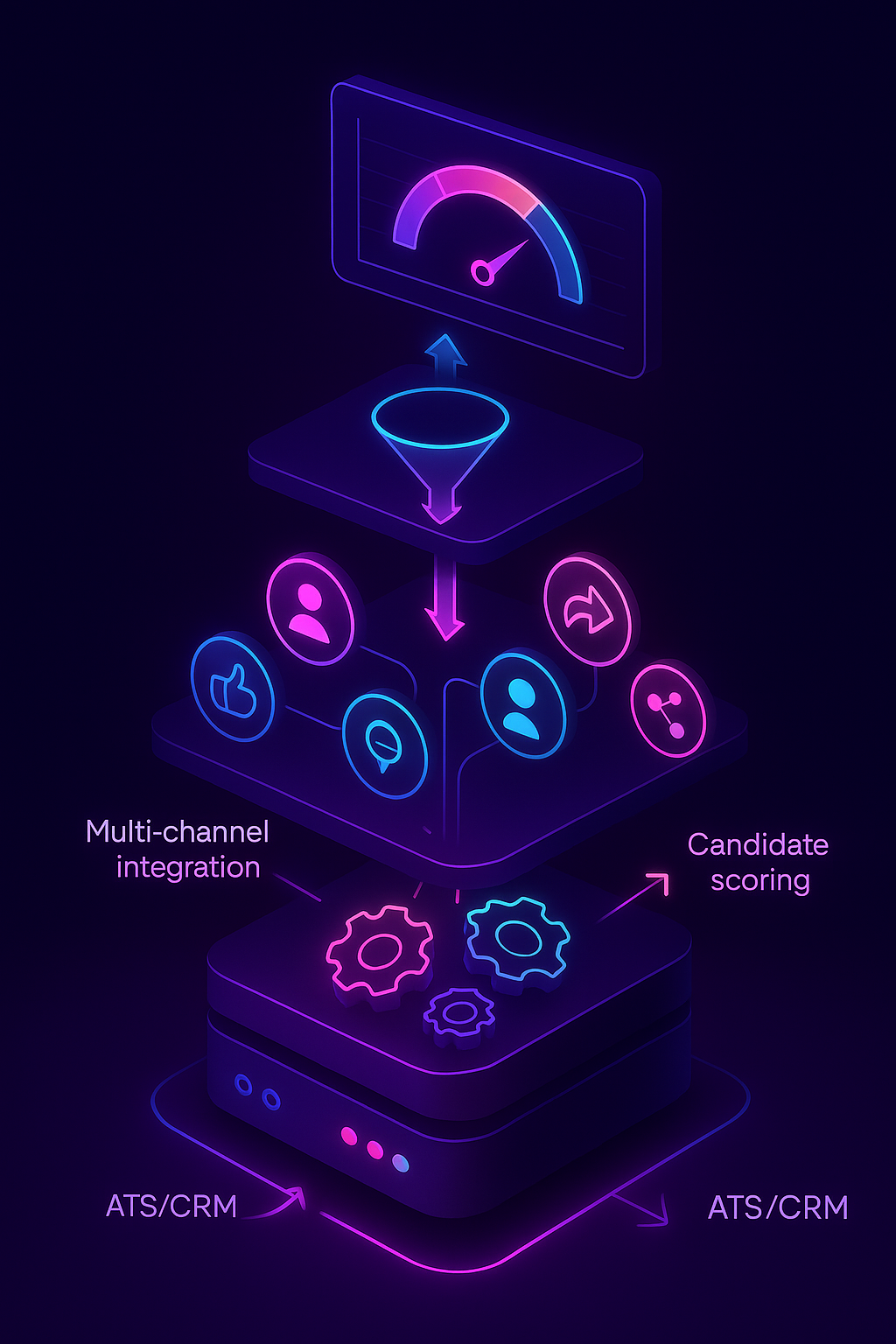
Inside a Modern Recruitment Marketing Automation Stack
A scalable talent engine requires several interlocking components. Here is what the modern stack looks like:
| Component | Purpose | Example Capability |
|---|---|---|
| Programmatic Ad Platform | Automates job ad placement and optimization | AI-powered targeting, real-time bidding |
| ATS/CRM Integration | Syncs candidate data seamlessly | Plug-and-play API connectors |
| Multi-Channel Sequencing | Reaches candidates where they are | Facebook, Instagram, LinkedIn, TikTok, Snapchat |
| Candidate Scoring | Prioritizes high-intent applicants | Smart scorecards, behavioral signals |
| Analytics Dashboard | Tracks ROI and informs decisions | CPM, CPC, CPA, time-to-hire tracking |
CRM and ATS synchronization enables seamless execution, ensuring that leads from social campaigns flow directly into existing hiring workflows without manual re-entry.
Platforms like Adway connect with any ATS and CRM, reaching candidates on Facebook, Instagram, Google, YouTube, LinkedIn, Snapchat, TikTok, Reddit, and Discord through a single interface.
How Does Programmatic Social Recruiting Reach Passive Talent at Scale?
Programmatic social recruiting automates ad placement, targeting, and optimization to surface candidates who are not actively job hunting. The approach works because social media recruiting today is less about broadcasting jobs and more about visibility, relevance, and timing.
Here is how it taps untapped talent pools:
AI-driven targeting: Analyzes real-time behavioral data to reach the most relevant talent instantly
Omnichannel reach: Candidates can be reached on nine social channels
Mobile-first journeys: Converts passive scrollers through friction-free application experiences
Always-on campaigns: Keeps pipelines warm between active requisitions
Research supports the impact. Drawing on studies including "The Effect of Social Media on Frictions and its Impact on Recruitment" (Kavak, 2024), the Social Recruiting Report 2025 highlights how social recruiting and programmatic advertising deliver more quality candidates, faster.
Key takeaway: Programmatic social recruiting shifts your strategy from reactive job posting to proactive talent attraction, engaging candidates before competitors even know they exist.
Which Recruitment Metrics Prove ROI and Quality at Scale?
Measuring recruitment marketing automation requires tracking both efficiency and quality. Here are the KPIs that matter:
| Metric | Benchmark | Why It Matters |
|---|---|---|
| Time-to-hire | Global median: 38 days | Measures speed of pipeline |
| Cost per application | Varies by channel; Meta at £5.17 CPM | Tracks ad efficiency |
| Candidate response rate | 60% increase with AI-powered outreach | Indicates engagement quality |
| Quality of hire | +36% improvement with automation | Validates long-term impact |
| Hiring speed with AI | Companies using AI hire 26% faster | Demonstrates automation ROI |
Channel-specific benchmarks also help guide investment:
LinkedIn engagement rate: 10.1%
Instagram engagement rate: 2.5%
TikTok apply start rate: 66%
(Wiser, 2026)
Tracking these metrics in a unified dashboard replaces spreadsheets and silos, allowing teams to optimize performance in real time.
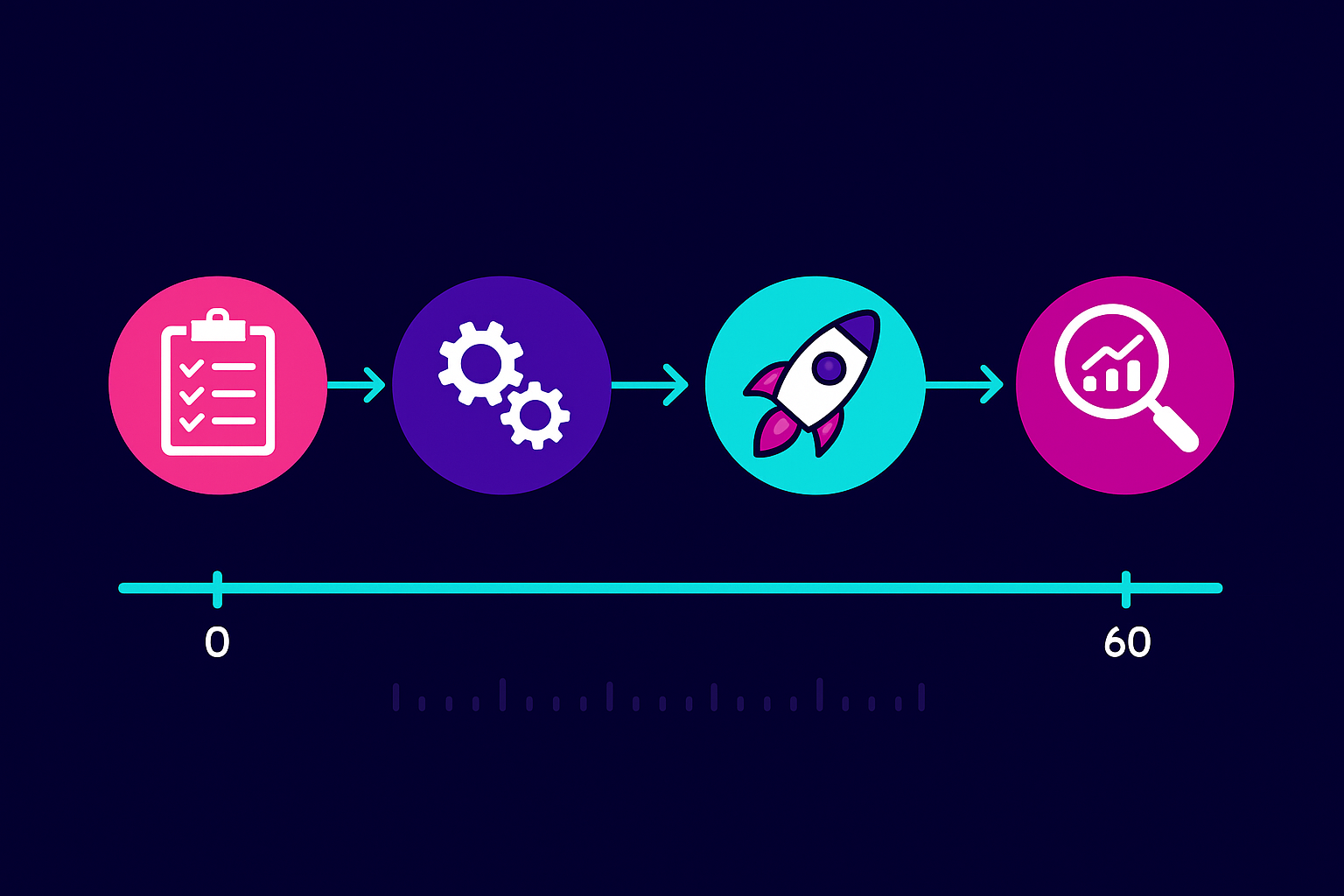
Implementation Roadmap: From Business Case to Go-Live in 60 Days
Rolling out recruitment marketing automation does not require a multi-year transformation. Here is a practical 60-day roadmap:
Weeks 1-2: Build the Business Case
Audit current cost-per-hire, time-to-fill, and source effectiveness
Identify passive talent gaps and underperforming channels
Align stakeholders on ROI targets
Weeks 3-4: Select and Configure the Platform
Evaluate platforms based on ATS integration, channel coverage, and analytics
With a plug-and-play API integration, new clients can be onboarded in as little as 6 weeks without disruption
Weeks 5-6: Pilot Campaigns
Launch initial campaigns targeting high-priority roles
Test creative variations and channel mix
Weeks 7-8: Analyze and Optimize
Review performance against benchmarks
Scale winning campaigns and reallocate spend
McKinsey analysis reveals the largest value potential for generative AI in HR (about 20 percent) is in talent acquisition, recruiting, and onboarding. The efficiency gains are real: Randstad contacted over 1.6 million profiles and uncovered 12,500 new active job seekers within just four weeks using AI-powered engagement.
Vendor Landscape: How Adway Stacks Up Against Other Platforms
"Programmatic social media job advertising has transformed from a niche recruitment tactic into a strategic imperative for talent acquisition teams."
(Adway Insights)
Here is how the leading platforms compare:
| Platform | Core Strength | Best For |
|---|---|---|
| Adway | AI-powered automation across all major social channels; seamless ATS integration | Mid-to-large enterprises seeking end-to-end social recruiting |
| LinkedIn Ads | Precision targeting across 1 billion professionals | Professional and executive recruitment |
| Meta Ads | Broad, cost-effective reach | High-volume and entry-level hiring |
| Joveo | Multi-channel campaign orchestration | Aggregated job advertising across boards and social |
| Pandologic | Job classification algorithms | Reducing wasted ad spend |
| Recruitics | Full-service agency model | Organizations wanting managed services |
Clients using Adway typically reduce time-to-hire by 20-30% and improve hire quality by more than 30%. PwC, for example, achieved a 33% uplift in quality of hire after deploying Adway's automated talent pipeline solution.
Adway has been recognized as a Core Leader in the 2025 Fosway 9-Grid for Talent Acquisition for the fourth consecutive year, validating its position among large international corporates seeking data-driven social recruiting.
Key Takeaways & Next Steps
Recruitment marketing automation is no longer optional for teams that need to scale hiring without scaling headcount. The path forward is clear:
Audit your current state: Identify bottlenecks in time-to-hire, cost-per-application, and passive candidate reach
Prioritize integration: Choose platforms that plug directly into your ATS and CRM
Start with pilots: Launch targeted campaigns, measure against benchmarks, and iterate
Invest in analytics: Track quality of hire alongside efficiency metrics
Think always-on: Build talent pipelines that stay warm between requisitions
The results speak for themselves. Nexer Recruit, a Swedish recruitment firm specializing in IT and tech talent, saw "381% more applications with Adway automated recruitment marketing" and shortened time-to-hire by 24%.
(Nexer Recruit Case Study)
For organizations ready to move beyond traditional job boards and tap into passive talent at scale, Adway offers a transparent, consumption-based approach to social recruiting that delivers agency-level results with SaaS-level efficiency.
Frequently Asked Questions
What is recruitment marketing automation?
Recruitment marketing automation involves using AI-driven software to automate job advertising, nurture talent, and sync data with ATS systems, allowing recruiters to focus on building relationships rather than managing manual tasks.
Why is traditional recruitment not effective for scaling?
Traditional recruitment methods, like job boards, only reach a small percentage of active job seekers and fail to engage passive candidates. Automation allows for proactive talent attraction, reaching a broader audience efficiently.
How does programmatic social recruiting work?
Programmatic social recruiting automates ad placement and targeting, using AI to analyze real-time data and reach passive candidates on multiple social channels, enhancing visibility and engagement.
What metrics are important for measuring recruitment marketing automation success?
Key metrics include time-to-hire, cost per application, candidate response rate, quality of hire, and hiring speed with AI. These metrics help track both efficiency and quality of recruitment efforts.
How does Adway integrate with existing recruitment systems?
Adway offers seamless integration with ATS and CRM systems through plug-and-play API connectors, ensuring that leads from social campaigns flow directly into existing hiring workflows without manual re-entry.
Sources
- https://adway.ai/insights/top-programmatic-social-media-job-advertising-platforms-for-2025
- https://intercode.com/cases/adway-ai-hr-tech-saas-app
- https://www.wonderkind.com/success-stories/raven51
- https://smartrecruiters.com
- https://adway.ai/integrations
- https://www.onrec.com/news/partnerships/eploy-announces-strategic-partnership-with-adway-to-transform-social-recruiting
- https://www.icims.com/wp-content/uploads/2022/11/iCIMS-The-Essential-Guide-to-Recruitment-Marketing-ebook.pdf
- https://adway.ai/why-use-social-recruiting-technology
- https://www.joveo.com/blog/top-social-media-recruiting-tools/
- https://www.mckinsey.com/mgi/our-research/agents-robots-and-us-skill-partnerships-in-the-age-of-ai
- https://beam.ai/use-cases/personalized-candidate-engagement-through-automated-outreach
- https://adway.ai/insights/social-recruiting-trends-2025
- https://wearewiser.com/blog/2025-recruitment-marketing-benchmarks-see-how-you-compare-and-boost-your-results
- https://www.mckinsey.com/capabilities/people-and-organizational-performance/our-insights/the-organization-blog/four-ways-to-start-using-generative-ai-in-hr
- https://www.hirevue.com/case-studies/randstad
- https://www.fosway.com
- https://adway.ai/