
How to Measure ROI from AI Recruiting Software in 2026
Discover how to measure ROI from AI recruiting software with metrics, frameworks, and tools to prove value and optimize hiring processes.

How to Measure ROI from AI Recruiting Software
Measuring ROI from AI recruiting software requires tracking four core metrics: time-to-hire, cost-per-hire, quality of hire, and recruiter productivity. Organizations implementing modern recruitment technology report 3.2x ROI within the first year, with leading platforms achieving 230% boost in ROI through automated targeting and real-time performance optimization.
TLDR
- AI recruiting software delivers measurable returns when organizations track the right KPIs: companies see 42% reduction in time-to-hire and 37% decrease in cost-per-hire
- Quality of hire improvements reach 35% through better candidate matching, though only 25% of talent leaders feel confident measuring this critical metric
- Real-time analytics platforms that track CPM, CPC, and CPA enable continuous optimization and prove financial impact to stakeholders
- Organizations following structured ROI frameworks achieve 3.2x returns within 12 months, with some reaching 23X ROI through AI-powered targeting
- GDPR compliance and human oversight requirements must factor into ROI calculations to avoid costly enforcement actions
AI recruiting software is reshaping hiring budgets, which means proving return on investment (ROI) has become board-level table stakes. Whether you are scaling a mid-market talent acquisition team or running recruitment for an enterprise with thousands of hires per year, the question is no longer if you should adopt AI-driven tools but how you will demonstrate their value.
This guide walks through the metrics, frameworks, and tooling you need to measure recruitment ROI with confidence.
AI recruiting software and the ROI question in 2026
Adoption of generative AI in HR has accelerated rapidly. The share of HR leaders actively planning or deploying GenAI jumped from 19% to 61% between mid-2023 and early 2026. Yet despite heavy investment, only 43% of organisations rate their talent acquisition technology stack as "good" or "excellent."
The gap between spending and perceived effectiveness explains why boards now expect recruiting leaders to prove ROI rather than promise it. Over 95% of US firms report using generative AI, but roughly 74% have yet to achieve tangible value from those initiatives.
The conclusion is straightforward: deploying AI recruiting software is only half the job. Measuring its financial impact is what separates strategic investments from sunk costs.
Why measuring ROI in recruiting matters more than ever
Unmeasured AI projects carry real financial risk. An unfilled technical role can cost between $450 and $900 per day in lost productivity. Scale that across dozens of vacancies and weeks of delay and the hidden cost quickly exceeds the price of the technology itself.
Poor hiring decisions compound the problem. A bad match can cost up to 30% of first-year salary, while organisations that invest wisely in their workforce see dramatically different outcomes. S&P 500 companies that excel at maximising return on talent generate 300% more revenue per employee compared with the median firm.
Organisations implementing modern recruitment technology report 3.2x ROI within the first year and continued growth in subsequent years. Those numbers only become visible when you track the right metrics and maintain a rigorous measurement framework.

Which metrics matter most for AI recruiting ROI?
Four quantitative levers feed a credible ROI model:
| Metric | What it measures | Benchmark improvement |
|---|---|---|
| Time-to-hire | Days from job posting to accepted offer | 42% reduction (42 days to 24 days) |
| Cost-per-hire | Total recruiting spend divided by hires | 37% decrease ($2,800 average savings per position) |
| Quality of hire | First-year performance, retention, hiring-manager satisfaction | 35% improvement as measured by performance ratings and retention |
| Recruiter productivity | Strategic hours freed by automation | 68% increase, allowing HR teams to focus on strategic initiatives |
Quality of hire deserves special attention. Although 89% of talent leaders believe it is increasingly important, only 25% feel confident in their ability to measure and improve it consistently. The metric itself combines lagging indicators such as retention and performance reviews with leading indicators including interview scores and competency coverage.
Human Capital ROI (HCROI) ties all of these together at the enterprise level. The formula is:
[HCROI = (Revenue – Operating Costs) / Total Labour Costs](https://www.adp.com/spark/articles/February 2026/measuring-human-capital-roi-helps-every-leader-make-smarter-decisions.aspx)
When you track HCROI alongside recruitment-specific KPIs, you can draw a straight line from hiring improvements to business results.
A step-by-step framework to calculate ROI
To maximise AI's value in recruitment, follow a structured approach that translates KPI movement into financial outcomes.
Establish a pre-AI baseline
Before rollout, measure where KPIs sit. Capture current time-to-hire, cost-per-hire, quality-of-hire signals, and recruiter time allocation. If your platform is already live, reconstruct the baseline from historical ATS data so you have a defensible comparison point.
Projecting financial impact
Set the business objective. Clarify whether you are targeting cost savings, faster hiring, or better quality. Each goal influences which KPIs take priority.
Select 3-5 KPIs. For most teams that means time-to-hire, cost-per-hire, quality-of-hire, and recruiter productivity.
Set targets. Use industry benchmarks or internal pilots to forecast improvements. For example, a 25% reduction in time-to-hire or a 10% lift in quality-of-hire scores.
Convert KPI movement into actual dollars. If each day saved on a vacancy eliminates $246 in productivity loss, multiply by the number of hires and average days saved to quantify the benefit.
Lead with Net Present Value (NPV). NPV is the clearest measure of value after the cost of capital and the metric CFOs use to approve projects.
The standard recruitment ROI formula from Metaview is:
Recruitment ROI = (net benefits of hiring / total recruiting costs) × 100
If your company spent $150,000 recruiting five engineers and those hires contributed $900,000 in project value in their first year, your ROI is 500%.
Organisations following a three-phase transformation model (Foundation Building, Process Optimisation, Advanced Integration) achieve 3.2x higher ROI and 37% reduction in hiring bias.
Key takeaway: Capture a baseline, define clear KPIs, and translate improvements into financial terms so the entire business understands the impact.
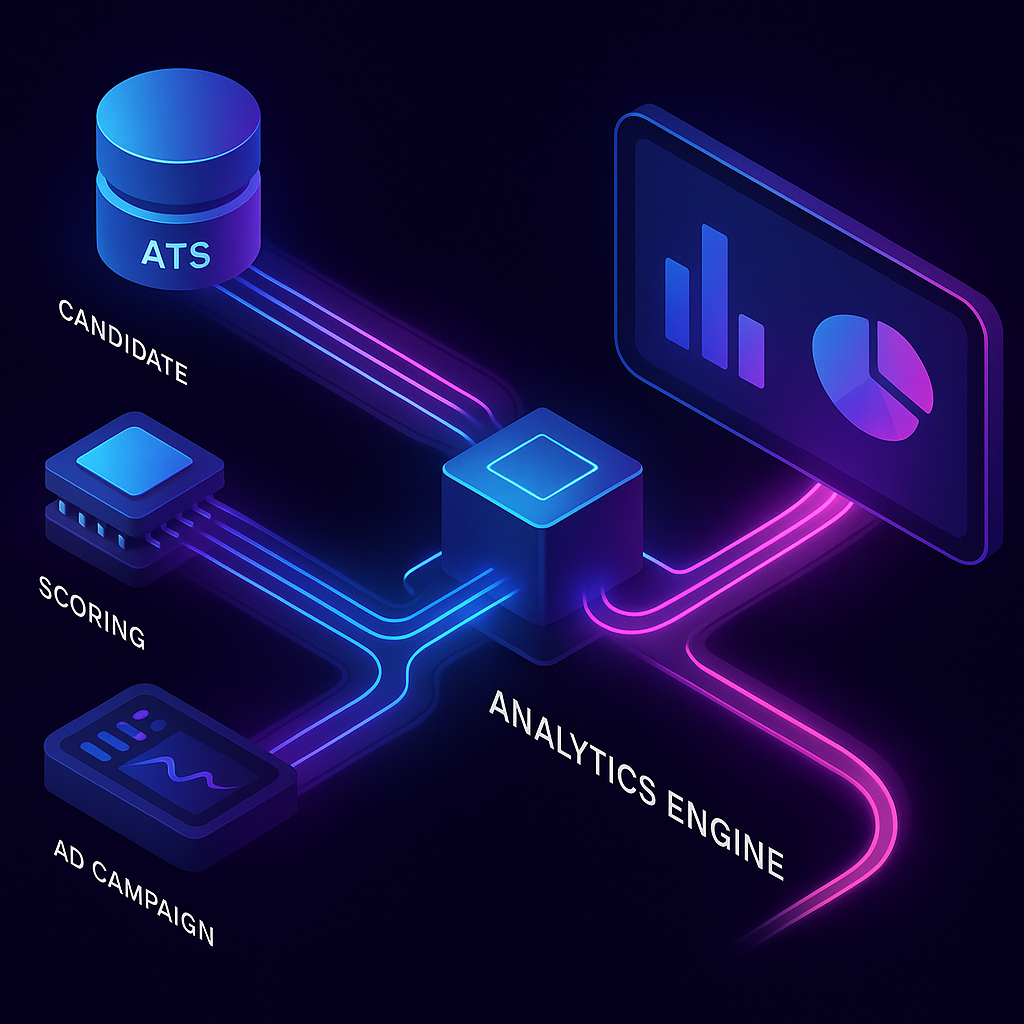
How the right data & tools turn metrics into real-time ROI insight
Proving ROI requires more than spreadsheets. Recruitment analytics platforms unify data from sourcing, advertising, and ATS workflows so you can monitor performance continuously.
Core capabilities to look for:
Real-time campaign tracking. Monitor CPM, CPC, and CPA to optimise ROI on programmatic social recruiting spend.
Candidate scoring. Measure quality and relevance throughout the hiring journey rather than waiting for post-hire performance reviews.
ATS integration. Seamless data flow between advertising and applicant tracking ensures integrated talent acquisition for better business outcomes.
Aggregated reporting and forecasting. Track time-to-hire, fill rate, and forecast budget requirements for current and future campaigns.
Only 43% of organisations rate their TA stack as effective, and a key differentiator among "Recruitment Technology Leaders" is significantly higher adoption of advanced analytics tools. Meanwhile, 14% of organisations use AI extensively, 49% use it to some extent, and 37% do not use it at all. The organisations that measure rigorously are the ones pulling ahead.
Adway's recruitment analytics software brings these capabilities together with AI-powered insights to predict hiring success, track performance, and prove ROI in a single dashboard.
Benchmarks & real-world payback: what good looks like
Industry benchmarks help contextualise your own results. The 2026 Recruitment Marketing Benchmark Report analysed 379 million job ad clicks and over 30 million applications, finding that cost-per-hire tracked around $851 with apply rates reaching 6.1% by year-end.
Client outcomes reinforce what strong ROI looks like in practice. Nexer Recruit, a Swedish firm specialising in IT and tech talent, partnered with Adway and achieved:
"Time to hire shortened by 24% measured conservatively." — Nexer Recruit case study
The collaboration also delivered a 381% increase in applications through automated recruitment marketing, with one-third of tech applications now sourced via the platform.
Studies of modern recruitment technology adoption show consistent results: a 42% reduction in time-to-hire (from 42 days to 24), a 37% decrease in cost-per-hire, and a 35% improvement in quality of hire as measured by first-year performance and retention. Organisations with these gains report 3.2x ROI within the first year.
Why does GDPR compliance matter for AI recruiting ROI?
Data protection is not a side issue. Non-compliance introduces legal risk that can wipe out any efficiency gain. The UK Information Commissioner's Office has audited several AI recruitment tool providers and made almost 300 recommendations covering fair processing, data minimisation, and transparency.
Key obligations under the UK GDPR and Data Protection Act 2018 include:
Article 22 restrictions. Solely automated decisions with legal or similarly significant effects require either contract necessity, legal authorisation, or explicit consent.
Human oversight. Organisations must allow candidates to contest decisions and regularly audit systems for accuracy and bias.
Data minimisation. Regulators found some tools collected far more information than necessary and retained it indefinitely.
From an ROI perspective, a single enforcement action or reputational incident can cost more than years of productivity savings. Bake compliance into your ROI model by factoring in the cost of audits, legal review, and potential penalties when evaluating vendors.
How leading platforms stack up on ROI potential
Choosing the right platform affects long-term payback. Public review data from G2 provides a snapshot of how buyers perceive the major players:
| Platform | G2 Rating | Primary segment | Notable strength | Notable gap |
|---|---|---|---|---|
| Beamery | 4.1 / 5 (158 reviews) | Enterprise | Candidate management, automated matching | Reporting depth |
| Phenom | 4.3 / 5 (378 reviews) | Enterprise | Criteria specificity | AI sourcing effectiveness |
| SmartRecruiters | 8.8 ease-of-use score | Enterprise | Applicant tracking, reporting | Contact sales for pricing |
Users highlight SmartRecruiters' strengths in automation (8.2) and reporting (8.3), while Beamery's reporting capabilities lag at 7.3. For organisations prioritising programmatic social recruiting and transparent pricing, Adway stands out with clients typically reducing time-to-hire by 20-30% and improving hire quality by more than 30%. Adway operates across 54 countries and integrates seamlessly with leading ATS and CRM systems, delivering the automation and measurable ROI that mid-market and enterprise teams need.
The ROI road map: start small, measure relentlessly
Proving the ROI of AI recruiting software comes down to disciplined measurement and the right technology partner.
Start with one high-impact use case. Reducing time-to-hire for hard-to-fill roles or cutting cost-per-application on social channels.
Capture a baseline before rollout. Without pre-AI data you cannot demonstrate improvement.
Track leading and lagging indicators. Combine interview scores and candidate quality signals with retention and performance outcomes.
Translate KPIs into financial impact. Use NPV and per-hire cost savings to build a business case the finance team will recognise.
Iterate. Use real-time dashboards to optimise campaigns and reallocate budget as you learn.
Adway is recognised as a Core Leader in the 2026 Fosway 9-Grid for Talent Acquisition, reflecting strong market performance and customer success at enterprise scale. If you are ready to connect recruitment performance to business impact and prove ROI, explore Adway's analytics and automation platform to see how leading organisations are turning hiring data into competitive advantage.
Frequently Asked Questions
What are the key metrics for measuring ROI in AI recruiting?
Key metrics include time-to-hire, cost-per-hire, quality of hire, and recruiter productivity. These metrics help quantify improvements and financial impact.
How does AI recruiting software impact time-to-hire?
AI recruiting software can significantly reduce time-to-hire by automating processes and improving candidate matching, leading to faster hiring decisions.
Why is measuring ROI in recruiting important?
Measuring ROI is crucial to justify investments in AI tools, ensuring they deliver tangible value and align with business objectives, avoiding sunk costs.
How can Adway's platform help in measuring recruitment ROI?
Adway's platform offers real-time analytics and integration with ATS systems, enabling organizations to track performance and prove ROI effectively.
What role does GDPR compliance play in AI recruiting ROI?
GDPR compliance is essential to avoid legal risks and penalties, which can negate productivity gains from AI recruiting software.
Sources
- https://www.myhiregenix.com/resources/roi-whitepaper.html
- https://www.gartner.com/en/human-resources/topics/artificial-intelligence-in-hr
- https://eightfold.ai/learn/hr-coms-future-of-recruitment-technologies-2025-26/
- https://www.worklytics.co/resources/proving-roi-ai-adoption-metrics-dashboards-2025
- https://index.dev/blog/ai-recruitment-roi-business-case
- https://www.mckinsey.com/capabilities/people-and-organizational-performance/our-insights/the-critical-role-of-strategic-workforce-planning-in-the-age-of-ai
- https://www.metaview.ai/resources/blog/quality-of-hire
- https://www.adp.com/spark/articles/2025/12/measuring-human-capital-roi-helps-every-leader-make-smarter-decisions.aspx
- https://you.com/articles/an-enterprise-guide-to-ai-roi-measurement
- https://www.metaview.ai/resources/blog/recruitment-roi
- https://www.aialpi.com/insights/the-roi-of-ai-in-recruitment-beyond-cost-savings
- https://adway.ai/data-performance-roi
- https://my.idc.com/getfile.dyn?attachmentId=47552096&containerId=IDC_P33092
- https://www.appcast.io/the-2025-recruitment-marketing-benchmark-report-is-live/
- https://ico.org.uk/for-organisations/uk-gdpr-guidance-and-resources/employment/recruitment-and-selection
- https://ico.org.uk/for-organisations/uk-gdpr-guidance-and-resources/individual-rights/individual-rights/rights-related-to-automated-decision-making-including-profiling
- https://www.g2.com/compare/beamery-vs-phenom-intelligent-talent-experience-platform
- https://www.g2.com/compare/beamery-vs-smartrecruiters
- https://adway.ai/insights/top-programmatic-social-media-job-advertising-platforms-for-2025
- https://www.fosway.com