
How to Build an AI-Powered Talent Acquisition Strategy
Discover how to create an AI-driven talent acquisition strategy to attract top talent efficiently and stay competitive in 2026.
How to Build an AI-Powered Talent Acquisition Strategy
Building an AI-powered talent acquisition strategy requires integrating programmatic advertising, social recruiting, and ATS systems to automate sourcing and screening while maintaining human oversight. Companies using AI recruiting tools hire 26% faster than those without, with leading platforms now capable of scanning thousands of profiles across multiple networks in minutes while reducing unconscious bias.
Key Facts
• Over 30 companies have emerged in the AI recruiting agents market, leveraging LLMs to streamline repetitive tasks end-to-end
• Organizations using AI achieve 295% increase in applications and save 800+ recruiter hours annually
• The recruitment software market will grow from $3 billion in 2025 to $6.2 billion by 2034
• 73% of job seekers aged 18-34 found their last position through social media platforms
• Fully integrated HR ecosystems deliver roughly twice the ROI of siloed systems
• Only 22% of recruiting executives currently have clear visibility into their hiring needs
Labour markets have shifted dramatically. Candidates scroll social feeds for hours each day, recruiters juggle 93 percent more applications than they did in 2021, and AI adoption in hiring has nearly doubled in a single year. Any forward-thinking organisation now needs an AI-powered talent acquisition strategy to compete for the talent that drives growth.
This guide walks through the pillars, platforms and practices that make such a strategy work, with practical examples you can adapt to your own hiring goals.
Why Does an AI-Powered Talent Acquisition Strategy Matter in 2026?
More than 30 companies have emerged in the AI recruiting agents and copilot market, leveraging large language models to streamline repetitive recruiting tasks end-to-end. That wave is not slowing. The recruitment software market is valued at USD 3 billion in 2025 and is projected to reach USD 6.2 billion by 2034, driven by AI-driven algorithms that improve candidate sourcing, screening and matching.
Yet many recruiting leaders still operate under pressure. According to Gartner, "Recruiting leaders face mounting pressures in 2025, from meeting CEO-driven growth targets to overcoming resource constraints and talent shortages." Only 22 percent of recruiting executives have visibility into their hiring needs for the current year, and 78 percent face stagnant or shrinking budgets.
An AI-powered approach addresses both sides of this equation. It automates labour-intensive tasks such as ad placement, screening and scheduling while surfacing passive talent who never visit job boards. The result is a faster pipeline, lower cost per hire and higher quality hires.
Key takeaway: Organisations that delay AI adoption risk falling behind competitors who already use data and automation to move faster and spend smarter.
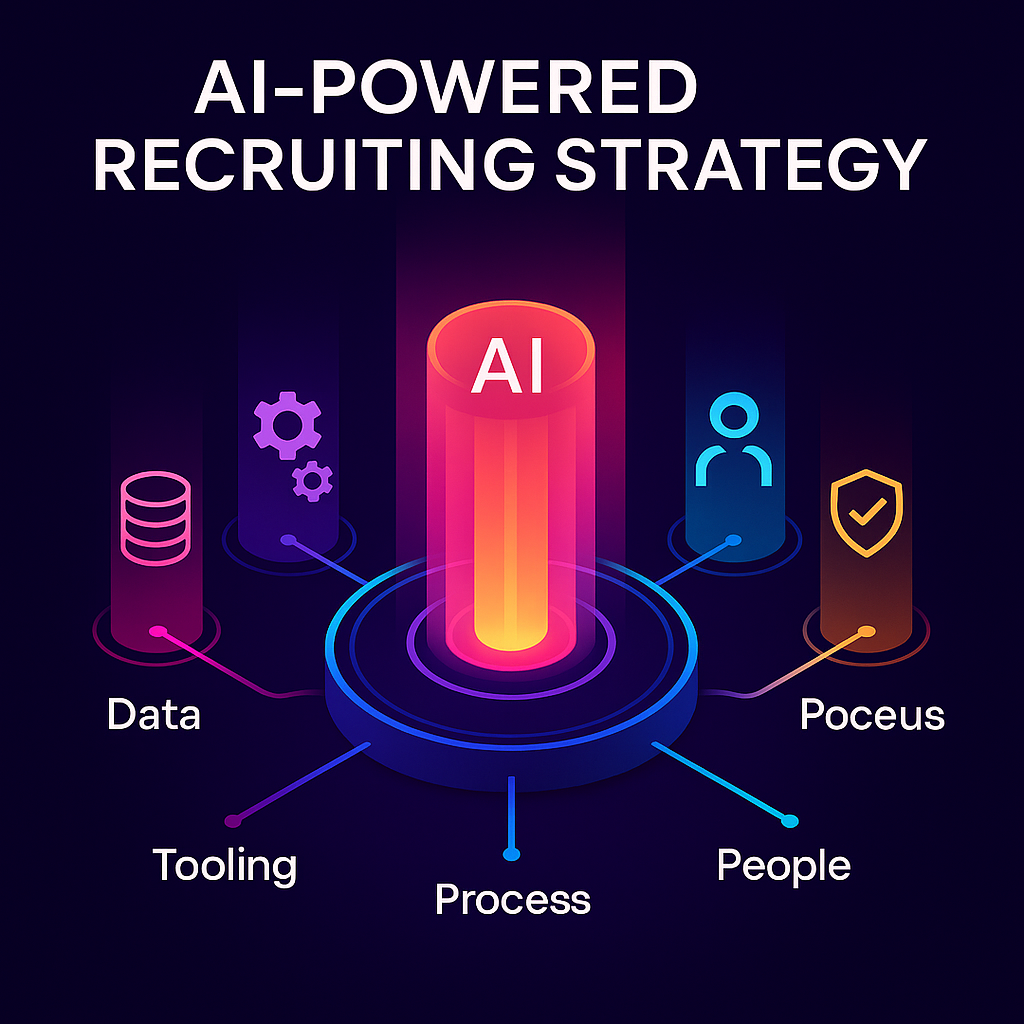
What Are the Five Pillars of an AI-Powered TA Framework?
Building an effective AI-powered strategy means more than buying new software. It requires aligning data, tooling, processes, people and governance into a coherent system.
| Pillar | What It Means | Why It Matters |
|---|---|---|
| Data | Clean, integrated candidate and performance data flowing across systems | Fully integrated HR ecosystems deliver roughly twice the ROI of siloed peers |
| Tooling | ATS, programmatic advertising, AI screening, analytics dashboards | Only 43 percent of organisations rate their TA stack as good or excellent |
| Process | Workflows redesigned around automation, not just bolted on | Businesses that embrace data-driven hiring "understand what activities lead to the employment of high-quality candidates and can increase investment in those areas" -- Lever |
| People | Recruiters upskilled to interpret data and manage AI outputs | 92 percent of HR leaders say their organisation cannot be competitive without great leaders |
| Governance | Policies for bias audits, compliance and responsible AI | Only 22 percent of recruiting executives have clear hiring visibility, underscoring the need for structured oversight |
Labour market intelligence should guide which pillars need the most attention in your context. For many teams, the starting point is integrating an ATS with social advertising tools so that leads flow directly into existing workflows.
Programmatic Job Advertising: Automating Reach, Spend & Quality
Programmatic job advertising is "the use of technology for buying, placing (distributing), and optimizing job ads -- and their associated budget -- automatically across the Internet," according to Joveo. Think of it as a recruitment co-pilot that automates ad placement across multiple platforms while using real-time data to decide where job postings will perform best.
Key benefits include:
- Smarter budget allocation. Programmatic rules stop spending on postings that already have enough applicants and redirect budget where need is greater.
- Wider reach. Leading platforms can distribute ads to more than 8,000 websites, social channels and job boards.
- Better candidate quality. Machine learning continuously improves results by adjusting placements, bids and targeting based on performance data.
Programmatic job advertising helps organisations make data-driven hiring decisions, reduce wasted ad spend, and improve quality of hire.
Where Adway Fits
Adway's social recruiting platform combines programmatic advertising with AI-driven targeting across Meta, Instagram, TikTok and LinkedIn. Several clients illustrate the impact:
- Nexer Recruit, a Swedish IT recruitment firm, saw "381% more applications with Adway automated recruitment marketing" and reduced time to hire by 24 percent. Today, one out of three tech applications comes through the platform.
- Ocab, a property damage restoration company, shifted from traditional job boards to social-first advertising. Applications for sanitation technician roles jumped from 5 to over 120, with "33% more quality hires" and a 65 percent faster time to hire.
- Mpya Finance achieved a "5x the scale and 300% increase in candidate inflow" after adopting a data-driven mindset and Adway's fully automated recruitment marketing solution.
These results demonstrate how programmatic social advertising can transform candidate pipelines when integrated with existing ATS workflows.
How Does Social Recruiting Scale Employer Branding?
Passive candidates are not browsing job boards, but they are scrolling social media. In fact, 90.71 percent of mobile users are active on social platforms. Social media recruiting is the art of finding, attracting, engaging and hiring candidates through those channels.
Why it matters:
- Influence on applications. 86 percent of job seekers say a company's social media presence influences their decision to apply.
- Younger talent. 73 percent of job seekers aged 18 to 34 found their last job through a social media platform.
- Retention. One organisation reported an 85 percent retention rate for hires sourced via social media.
Social recruiting also elevates employer branding. Candidates engage with brands at hundreds of digital touchpoints before ever seeing a job posting. Platforms such as LinkedIn, Instagram and TikTok each serve different audiences and content styles, so a multi-channel approach reaches both experienced professionals and early-career talent.
Designing a Mobile-First Application Journey
Over 70 percent of job seekers use mobile devices during their search. A poorly optimised experience leads to high drop-off rates. Candidates abandon applications in under two minutes if the process feels clunky.
Best practices to cut mobile drop-offs:
- Audit your mobile experience. Use tools like Google's Mobile-Friendly Test and compress images so pages load in under two seconds.
- Simplify the application. Enabling mobile applications can increase submissions by 11 percent. Enable autofill and allow candidates to import LinkedIn profiles.
- Use SMS reminders. Text messaging keeps candidates engaged with interview deadlines and application updates.
- Keep content short. Embed videos under 60 seconds and format job descriptions for easy scrolling.
Adway's mobile-first application journeys are designed to convert passive candidates who discover opportunities in their social feeds, reducing friction from first click to completed application.
Connecting the Dots: ATS Integration & Data-Driven Decision Making
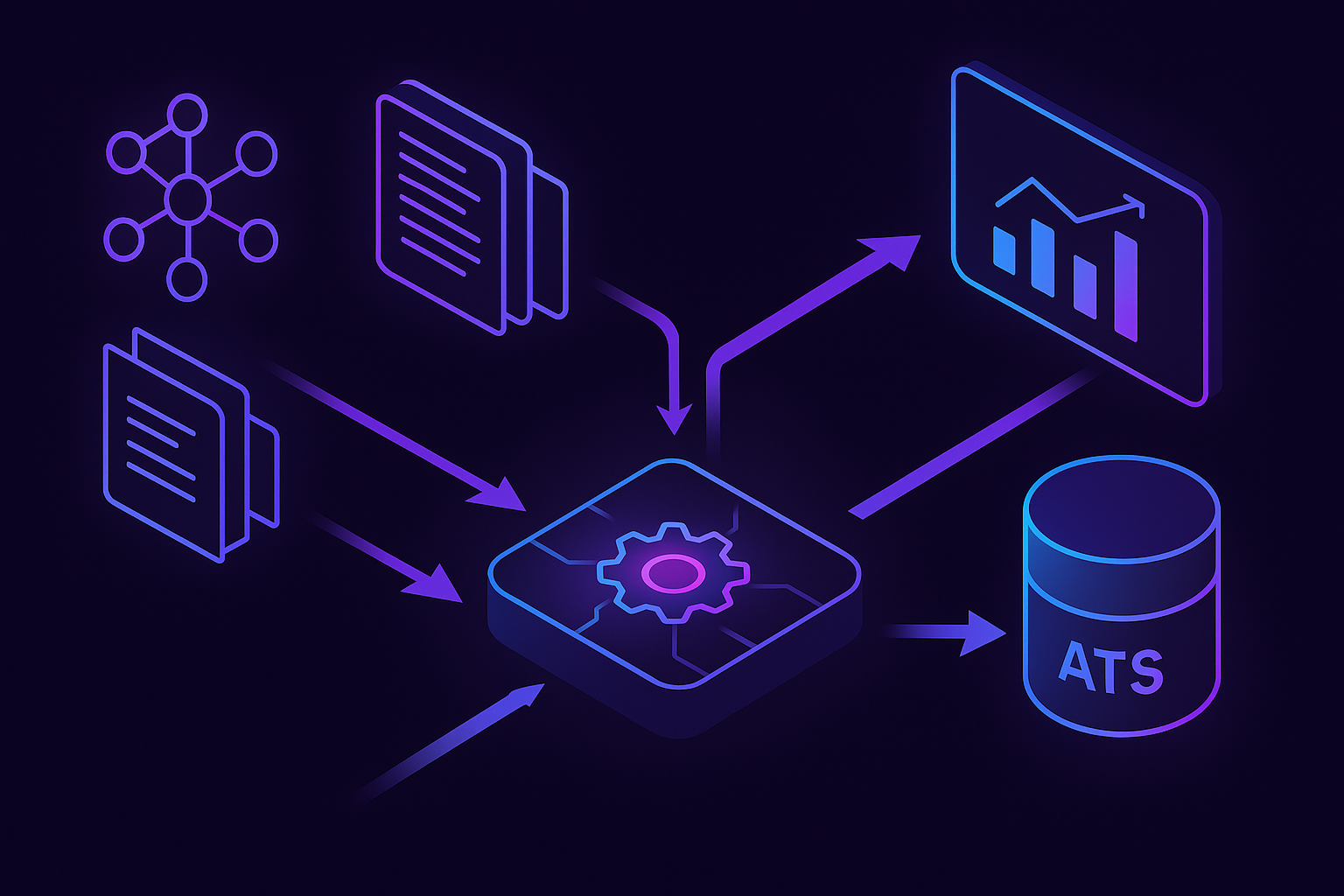
An AI-powered strategy only works when data flows seamlessly between systems. A unified ATS API enables developers and product managers to access recruiting data from multiple platforms through a single, standardised interface. That means writing code once to support Greenhouse, Lever, Workable and more.
Why integration matters:
- ROI impact. Fully integrated HR ecosystems deliver roughly twice the ROI of siloed peers.
- Real-time data. Live API access ensures recruiters always have up-to-date candidate information without manual syncing.
- AI-ready infrastructure. By 2026, half of enterprises are expected to require AI-driven capabilities in their HCM systems for personalised experiences and proactive workforce management.
Data-driven recruiting empowers recruiters to optimise the entire hiring process. Teams can analyse lead-sourcing insights, adjust strategies based on funnel performance and share metrics with stakeholders to align hiring with business goals.
Production AI use cases have doubled to over 30 percent, led by onboarding automation, HR document creation and AI-assisted job postings. Average HR-AI budgets are now around USD 1.6 million for 2026, representing roughly tenfold growth since 2023.
Adway's plug-and-play ATS integrations ensure that social campaign leads flow directly into existing applicant tracking systems with minimal disruption, giving recruiters a single source of truth from first impression to hire.
How Do You Keep AI in Recruitment Responsible and Compliant?
AI offers efficiency, but it also introduces risks. UK Government guidance notes that AI-enabled recruitment tools "pose novel risks, including perpetuating existing biases, digital exclusion, and discriminatory job advertising and targeting." Tools for trustworthy AI, including assurance mechanisms and global technical standards, can help manage these risks.
Key considerations:
- Adverse impact analysis. The EEOC's four-fifths rule states that one selection rate is substantially different from another if their ratio is less than 80 percent. Employers should evaluate algorithmic tools and adjust them to reduce adverse impact.
- Bias audits. Regular audits ensure AI-based assessments produce scores that are fair and unbiased. All development and scoring steps should be documented for verification.
- Data protection. Completing a Data Protection Impact Assessment is required for AI systems that involve personal data.
- Human oversight. AI should augment recruiters, not replace human judgment on final hiring decisions.
Adway's algorithms are designed to be bias-free, ensuring fair and diverse hiring without human skew, while seamless ATS integrations maintain full audit trails.
Which Talent Acquisition Metrics Prove ROI?
Vanity metrics like impressions and follower counts look impressive in reports but do not necessarily correlate with business outcomes. A robust measurement framework connects social media effectiveness to actual hiring results.
| Metric | Definition | Benchmark |
|---|---|---|
| Time to hire | Days from application to accepted offer | Global median is 38 days; companies using AI hire 26 percent faster |
| Cost per hire | Total recruiting expense divided by hires | Varies by role; programmatic advertising often lowers cost per application |
| Quality of hire | Performance and retention of new hires | Track 90-day and first-year retention against source |
| Source of hire | Channel that delivered the successful candidate | Sourced candidates are 8x more likely to be hired |
| Offer acceptance rate | Offers accepted divided by offers extended | 82 percent in 2025, the highest since 2021 |
To calculate ROI, use the formula: ROI = (Benefits -- Costs) / Costs. Benefits include the monetary value of outcomes such as reduced time to fill and improved retention. Costs include ad spend, technology fees and recruiter time. -- LinkedIn Advice
Companies using AI recruiting tools are hiring 26 percent faster than those without AI support. Tracking these metrics over time reveals which channels and tactics deliver the strongest return.
Conclusion & Next Steps
An AI-powered talent acquisition strategy combines data, tooling, process, people and governance into a system that attracts stronger candidates faster while cutting cost per hire. Programmatic job advertising automates reach and spend; social recruiting engages passive talent where they already spend time; ATS integration ensures data flows seamlessly; and responsible AI practices protect both candidates and employers.
Adway has been recognised as a Core Leader in the 2025 Fosway 9-Grid for Talent Acquisition, validating its position in the European TA tech market among large international corporates. If you are ready to move beyond manual targeting and fragmented data, exploring a platform that unifies social recruiting, programmatic advertising and ATS integration is a logical next step.
Start by auditing your current tech stack, identifying integration gaps, and piloting AI-driven campaigns on the channels where your target candidates spend the most time. The organisations that act now will be the ones filling roles faster and with higher quality hires in the months ahead.
Frequently Asked Questions
What are the benefits of an AI-powered talent acquisition strategy?
An AI-powered talent acquisition strategy automates labor-intensive tasks like ad placement and candidate screening, leading to a faster hiring pipeline, reduced cost per hire, and higher quality hires. It also helps in engaging passive talent who do not visit job boards, thus expanding the talent pool.
How does programmatic job advertising enhance recruitment?
Programmatic job advertising automates the buying, placing, and optimizing of job ads across the internet. It uses real-time data to allocate budgets smartly, ensuring ads are placed where they perform best, thus improving candidate quality and reducing wasted ad spend.
What role does social recruiting play in employer branding?
Social recruiting helps in engaging passive candidates who are active on social media platforms. It influences job seekers' decisions to apply and is crucial for reaching younger talent. A strong social media presence can significantly enhance employer branding and improve retention rates.
How does Adway's platform integrate with existing recruitment systems?
Adway's platform offers seamless ATS integrations, allowing social campaign leads to flow directly into existing applicant tracking systems. This integration ensures a unified data flow, enabling recruiters to have a single source of truth from first impression to hire.
What are the key metrics to measure the ROI of a talent acquisition strategy?
Key metrics include time to hire, cost per hire, quality of hire, source of hire, and offer acceptance rate. These metrics help in assessing the effectiveness of recruitment strategies and the impact of AI tools on hiring speed and quality.
Sources
- https://www.smartrecruiters.com/resources/guides/global-recruiting-benchmarks/
- https://www.cbinsights.com/research/recruiting-ai-agents-copilots-market-traction/
- https://eightfold.ai/wp-content/uploads/hr_future_of_ai_and_recruitment_technologies_report-1.pdf
- https://pdf.marketpublishers.com/oganalysis/recruitment-software-market-og.pdf
- https://www.gartner.com/en/human-resources/topics/hr-recruiting-strategy
- https://isg-one.com/advisory/hr-technology-and-transformation/2025-hr-tech-survey-report
- https://eightfold.ai/learn/hr-coms-future-of-recruitment-technologies-2025-26/
- https://www.lever.co/blog/data-driven-recruitment/
- https://www.gartner.com/en/human-resources/topics/talent-management
- https://www.joveo.com/programmatic-job-advertising-the-ultimate-guide/
- https://info.recruitics.com/blog/programmatic-job-advertising-guide
- https://info.appcast.io/whitepaper/programmatic-recruitment-advertising-website
- https://www.symphonytalent.com/solutions/programmatic-media/
- https://www.careerarc.com/social-media-recruiting/
- https://www.peoplescout.com/insights/social-media-metrics-for-recruitment/
- https://talenteam.com/blog/mobile-first-recruiting/
- https://stateofcx.phenom.com/
- https://hiring.monster.com/resources/recruiting-strategies/talent-acquisition/mobile-job-apply/
- https://docs.unified.to/ats/overview
- https://business.linkedin.com/talent-solutions/resources/talent-strategy/data-driven-recruiting
- https://www.gov.uk/government/publications/responsible-ai-in-recruitment-guide/responsible-ai-in-recruitment
- https://www.robinsonbradshaw.com/assets/htmldocuments/Select%20Issues%20Assessing%20Adverse%20Impact%20in%20Software%20Algorithms%20and%20Artificial%20Intelligence%20Used%20in%20Employment%20Selection%20Procedures%20Under%20Title%20VII%20of%20the%20Civil%20Rights%20Act%20of%201964.pdf
- https://www.siop.org/wp-content/uploads/legacy/SIOP-AI%20Guidelines-Final-010323.pdf
- https://www.gem.com/resource/recruiting-benchmarks
- https://www.linkedin.com/advice/0/how-do-you-measure-roi-your-recruitment-marketing
- https://www.fosway.com