
Global Talent Acquisition Strategy Template for 2026
Explore the 2026 global talent acquisition strategy template, comparing automated AI approaches with manual methods for future-ready hiring.

Global Talent Acquisition Strategy Template for 2026
A global talent acquisition strategy in 2026 requires automated systems that leverage AI-powered targeting, programmatic advertising, and social recruiting to overcome the projected 85 million skilled worker shortage by 2030. Companies using automation achieve 59% faster time-to-hire and 36% better quality of hire compared to manual processes, as manual targeting simply can't keep up with modern recruitment demands.
At a Glance
• Only 12% of HR leaders conduct strategic workforce planning with 3+ year focus, while 84% plan to adopt AI in 2026
• Automated platforms deliver measurable ROI: €194 return per €1 spent and 54% reduction in cost per application
• Manual recruitment struggles with scale: recruiters handle 14 job reqs simultaneously, a 56% increase since 2021
• Social recruiting reaches 4.9 billion active users spending 2.5 hours daily on platforms
• Real-world results: Apoteket reduced time-to-hire from 88 to 31 days; Ocab increased applications from 5 to 120+ per role
• Compliance requirements include GDPR consent for targeting and transparency in automated decision-making
The global shortage of skilled workers is projected to reach more than 85 million by 2030. That stark reality makes one thing clear: your 2026 global talent acquisition strategy cannot rely on manual processes. Automation outperforms traditional recruitment tactics in every measurable dimension. This template compares automated approaches, like AI-powered social recruiting, with manual methods such as IAmGaia's workflows, giving you a practical framework to build a future-ready hiring engine.
Why Should Your 2026 Global Talent Acquisition Strategy Go Automated?
A global talent acquisition strategy is an integrated plan that aligns hiring processes, technology, and employer branding across all regions to meet future workforce needs. It analyses labour-market data, defines target skills, and sets standard KPIs so teams can source, engage, and hire talent at scale.
The case for automation is compelling. Only 12 percent of HR leaders say they do strategic workforce planning with at least a three-year focus. Meanwhile, 82% of employers already use social media to seek out, recruit, and engage candidates with outstanding results.
As Jeanne MacDonald, CEO of Recruitment Process Outsourcing at Korn Ferry, puts it: "We need to embrace AI but not lose sight of the bigger picture. Talent acquisition is about people, and human intelligence will always be the differentiator."
The numbers support a hybrid model where automation handles repetitive tasks while humans focus on relationship-building:
- 84% of talent leaders plan to use AI next year
- 4.9 billion people are active on social media, spending an average of 2.5 hours daily scrolling
- Manual targeting simply cannot keep up with today's social recruiting technology
Key takeaway: Automated strategies reach passive candidates at scale while manual processes struggle to match the speed and precision required for 2026 hiring demands.

What Macro Drivers Are Shaping Talent Acquisition in 2026?
Several converging forces are pushing organisations toward automated solutions.
Skill Shortages and Hiring Challenges
The global shortage of skilled workers is projected to reach more than 85 million by 2030. Current hiring success rates in Europe stand at just 46%, with offer acceptance rates at only 56% and 18% of new hires leaving during their probationary period.
AI Investment Acceleration
Enterprises worldwide are expected to invest $166 billion on AI solutions in 2023, with spending projected to grow to $423 billion by 2027 at a CAGR of 26.9%.
Technology Stack Gaps
Only 43% of organisations rate their talent acquisition stack as "good" or "excellent." Organisations defined as "Recruitment Technology Leaders" demonstrate significantly higher adoption of advanced tools compared to "RT Laggards."
| Driver | Impact | Solution |
|---|---|---|
| 85M+ skill shortage by 2030 | Increased competition for talent | Automated passive candidate reach |
| 46% hiring success rate | Wasted resources on failed hires | AI-driven candidate scoring |
| 43% tech stack satisfaction | Missed automation opportunities | Integrated programmatic platforms |
Key takeaway: Macro pressures demand technology that scales globally while maintaining candidate quality.
How Do AI, Social & Programmatic Recruiting Build the Automated Core?
Building an automated talent acquisition engine requires three interconnected components: AI-powered targeting, social recruiting infrastructure, and programmatic ad management.
AI-Powered Precision
"Manual targeting simply can't keep up with today's social recruiting technology." AI-driven analysis of real-time behavioural data targets the most relevant talent instantly, while bias-free algorithms ensure fair and diverse hiring without human skew.
Automated platforms demonstrate measurable outcomes:
- Cut time-to-hire by 59%
- Boost quality of hire by +36%
- Candidate scoring measures quality and relevance throughout the entire hiring journey
Social Recruiting at Scale
Your next great hire is not scouring job boards. They are on social media, just like 4.9 billion others. With AI-driven targeting and access to 5.07 billion social media users, automated platforms ensure campaigns reach the most qualified candidates.
Programmatic Campaign Management
Real-time data helps you stay on top of views, clicks, and candidate flows. Performance metrics optimise ROI with CPM, CPC, and CPA tracking across multiple platforms including Facebook, Instagram, LinkedIn, TikTok, and Discord.
Seamless ATS Integration
Automation only works if it connects to your existing systems. Modern platforms connect with any ATS and CRM, integrating seamlessly with the systems you already use.
Applicant Tracking Systems allow enterprises to streamline the process of managing applications by consolidating hiring workflows. ATS provides the ability to perform multiple operations such as storing, scoring, screening, and sorting candidate resumes based on job details.
When selecting an ATS, consider that it is a critical decision for hiring and business success. SmartRecruiters, for example, has helped over 4,000 customers transform their hiring processes.
Key takeaway: The automated core connects AI targeting, social reach, and ATS integration into a unified system that scales globally.
Where Does IAmGaia's Manual Model Fall Short?
Understanding IAmGaia's approach helps illustrate the limitations of manual workflows in 2026's competitive landscape.
IAmGaia positions itself as a programmatic social recruitment platform. According to their own comparison, several customers who previously used other platforms have switched to Gaia for performance-led targeting and flexibility. Gaia emphasises that their platform adapts in real time and offers a 45-second mobile-first application UX.
However, manual elements persist in Gaia's model. The platform offers managed or self-serve options, and while they promise to "deploy campaigns swiftly," the reliance on manual data entry and campaign creation for some service tiers creates friction.
Where Manual Processes Struggle
The average recruiter now handles 14 job reqs simultaneously on any given day, a 56% increase compared to 2021. Applications per recruiter have grown from 925 in 2021 to 2,479 in 2024.
Job boards and social sites dominate the application pool, accounting for nearly half (49.0%) of all applications. Yet, they contribute less than a quarter (24.6%) of actual hires.
Cost pressures compound the challenge. Cost per click increased for 86% of industries in 2024, with some seeing increases over 25% year over year.
| Factor | Manual Challenge | Automated Solution |
|---|---|---|
| Recruiter workload | 2.7x more applications vs 2021 | AI-powered screening and scoring |
| Source efficiency | 49% of applications, 24.6% of hires | Programmatic targeting optimisation |
| Cost management | 10% average CPC increase | Real-time budget allocation |
Key takeaway: Manual workflows cannot scale to meet recruiter workload demands or optimise spend across channels effectively.
Which Metrics Prove ROI in 2026?
Measuring recruitment ROI requires tracking metrics that connect activity to business outcomes.
Core Benchmarks
The global median time to hire is 38 days. Companies using AI in their recruiting processes hire 26% faster. On average, there are 73 applicants per role, 3 applicants interviewed, and only 1 offer made.
Technology ROI Metrics
Modern recruitment technology delivers measurable returns:
- 42% reduction in time-to-hire, from an average of 42 days to 24 days
- 37% decrease in cost-per-hire, with average savings of $2,800 per position
- 35% improvement in quality of hire, as measured by first-year performance ratings and retention
- 3.2x ROI within the first year of implementation
2026 KPI Template
| Metric | Benchmark | Target |
|---|---|---|
| Time-to-hire | 38 days global median | Sub-30 days with AI |
| Applications per role | 73 average | Quality over quantity |
| Cost per application | Industry varies | 54% reduction possible |
| Quality of hire | Track 1-year retention | +35% improvement |
| AI adoption impact | 26% faster hiring | Scale across regions |
Automated platforms demonstrate these outcomes in practice, achieving a €194 return for every €1 spent and reducing cost per application by 54%.
Key takeaway: Track time-to-hire, cost-per-application, and quality of hire to demonstrate automation ROI.
Compliance & Ethical Guardrails for Automated Targeting
Automated recruitment advertising operates within complex regulatory frameworks that require careful attention.
GDPR and EDPB Guidelines
The European Data Protection Board's guidelines address targeting of social media users, noting that targeting services make it possible for organisations to communicate specific messages to users to advance commercial or other interests. Mechanisms to target social media users have increased in sophistication over time.
Critically, targeting of social media users may involve uses of personal data that go against individuals' reasonable expectations and thereby infringe applicable data protection principles.
UK ICO Requirements
The use of storage and access technologies for online advertising purposes requires consent. Contextual advertising more readily enables compliance with both PECR requirements and UK GDPR obligations than other types of targeted advertising.
Bias and Transparency
The EDPB notes that the potential for discrimination in targeting arises from the ability for advertisers to leverage extensive personal data gathered about users. Additionally, automated systems require transparency about how algorithms make decisions.
Automated bidding on platforms has an 85% adoption rate, making governance frameworks essential.
Compliance Checklist:
- Obtain valid consent for data processing in recruitment advertising
- Document the legal basis for targeting criteria
- Implement bias monitoring for AI-driven screening
- Maintain transparency about automated decision-making
- Ensure data minimisation in candidate profiling
Key takeaway: Build compliance into your automated strategy from the start rather than retrofitting governance later.
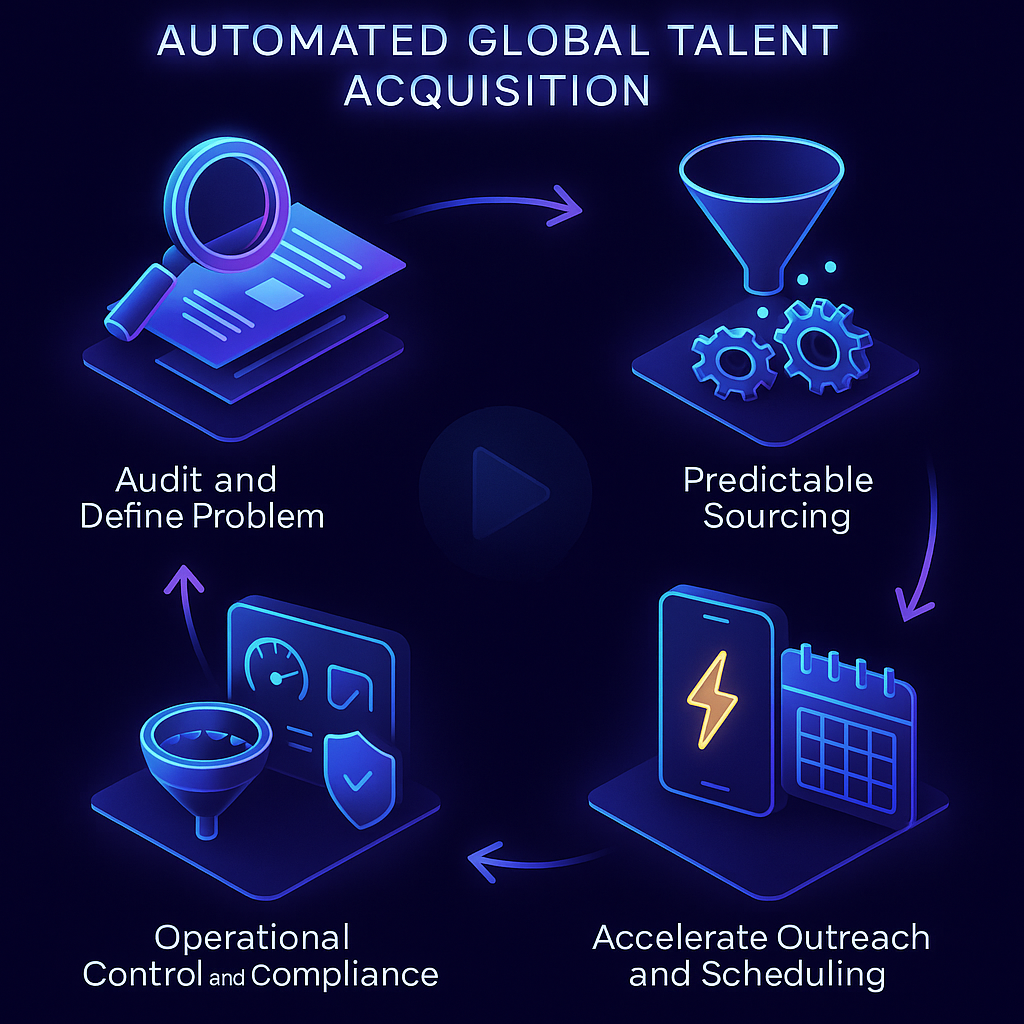
Implementation Checklist & Editable Template
Operationalising your global talent acquisition strategy requires systematic implementation across four pillars.
Pillar 1: Define the Problem
As one industry guide notes, "It's so important to understand simply the problem being solved." Business goals and environments constantly change, so TA requirements must adapt.
Actions:
- Audit current time-to-hire by region and role type
- Calculate cost-per-hire across channels
- Map candidate drop-off points in your funnel
- Identify roles with persistent vacancy issues
Pillar 2: Build Predictable Sourcing
Top-of-funnel volume is often inconsistent, and teams drown in unqualified resumes. The fix is always-on, multi-channel sourcing with automated enrichment and duplicity checks.
Actions:
- Activate programmatic campaigns across Meta, LinkedIn, TikTok
- Implement AI-driven candidate scoring
- Connect sourcing to ATS with real-time data flow
- Set up automated nurturing sequences
Pillar 3: Accelerate Outreach and Scheduling
Weeks can evaporate in email ping-pong and calendar chaos. Sequenced outreach with self-serve scheduling reduces time-to-first-interview.
Actions:
- Deploy automated interview scheduling
- Create mobile-first application flows
- Implement 24-hour response SLAs
- Track stage conversion rates
Pillar 4: Establish Operational Control
Leaders need visibility into bottlenecks, SLAs, and compliance risk. Real-time dashboards covering time-to-hire, offer-acceptance, and stage conversion enable accountability by design.
Actions:
- Configure dashboard reporting by region
- Set up bias monitoring alerts
- Create audit trails for compliance
- Establish escalation workflows
Technology Evaluation Framework
Open APIs mean companies can connect and complement other HR tech and TA systems. Data is often central to all TA tech, so ensure your stack demonstrates business impact.
| Evaluation Criteria | Questions to Ask |
|---|---|
| Integration | Does it connect with your ATS? |
| Scalability | Can it support global campaigns? |
| Analytics | What metrics are tracked? |
| Compliance | Does it support GDPR requirements? |
| Support | What is the implementation timeline? |
AI will not make most human skills obsolete, but it will change how they are used. Build your strategy with this hybrid model in mind.
Real-World Proof: Apoteket, Ocab & PwC Results
These case studies demonstrate measurable automation impact across different industries and use cases.
Apoteket AB: From Reactive to Strategic
Apoteket AB, Sweden's leading pharmacy chain, faced significant recruitment challenges with an outdated ATS, fragmented processes, and inconsistent candidate experiences.
Under the leadership of Carolina, Head of Talent Acquisition, Apoteket transformed its approach by centralising processes, modernising employer branding, and leveraging data-driven insights through an automated social recruiting platform.
Results:
- "Apps per vacancy rose from 5 to 23," creating a diverse candidate pool for every role.
- Time to Attract reduced from 32 to 12 days
- Time to Hire cut from 88 to 31 days
Ocab: 65% Faster Time-to-Hire
Ocab, a market leader in property damage restoration and sanitation across Sweden, struggled to attract quality candidates through traditional job boards.
After implementing Social Recruiting Technology, Ocab experienced transformative results:
- "Applications for sanitation technician roles jumped from 5 to 120+"
- 33% more quality hires compared to before
- Time-to-attract reduced from 34 days to just 12
PwC Sweden: Eliminating Drop-Off
PwC Sweden faced a cumbersome recruitment process that required 22 clicks to apply, resulting in drop-off rates as high as 70-80%.
Social Recruiting Technology enabled PwC to reduce the application from 22 clicks to just 5. The transformation enabled PwC to benefit from full source attribution and ROI visibility, tracking campaign effectiveness from first click to hire.
| Company | Challenge | Solution | Result |
|---|---|---|---|
| Apoteket | 88-day time-to-hire | Automated social recruiting | 31-day time-to-hire |
| Ocab | 5 applications per role | Programmatic targeting | 120+ applications per role |
| PwC | 70-80% drop-off rate | Mobile-first flow | 5-click application |
Bringing It All Together
The evidence is clear: automation delivers measurable advantages across every talent acquisition metric that matters. From Apoteket's 59% reduction in time-to-hire to Ocab's 33% improvement in quality of hire, organisations that adopt AI-powered social recruiting outperform manual approaches.
The macro drivers are not slowing down. With 85 million skilled workers projected to be in shortage by 2030 and only 43% of organisations rating their tech stack as effective, the gap between leaders and laggards will widen.
Your implementation checklist provides a practical starting point:
- Audit your current state metrics
- Activate programmatic social campaigns
- Integrate with your ATS for seamless data flow
- Measure against the 2026 benchmarks
- Iterate based on real-time performance data
Adway, recognised as a Core Leader in the 2025 Fosway 9-Grid for Talent Acquisition for the fourth consecutive year, offers an AI-driven social recruiting platform that integrates seamlessly with existing systems. With demonstrated results including €194 return for every €1 spent and operations across 54 countries, the platform provides a proven foundation for global talent acquisition strategies.
The choice is not between automation and human judgment. It is about deploying each where they deliver the most value. Automation handles scale, speed, and precision. Humans provide the relationships, critical thinking, and strategic decisions that no algorithm can replace.
Your 2026 strategy starts with that partnership.
Frequently Asked Questions
What is a global talent acquisition strategy?
A global talent acquisition strategy is an integrated plan that aligns hiring processes, technology, and employer branding across regions to meet future workforce needs. It involves analyzing labor-market data, defining target skills, and setting KPIs to source, engage, and hire talent at scale.
Why should companies automate their talent acquisition strategy in 2026?
Automation in talent acquisition allows companies to reach passive candidates at scale, handle repetitive tasks efficiently, and improve precision in targeting. This is crucial as manual processes struggle to keep up with the speed and demands of modern hiring environments.
What are the macro drivers influencing talent acquisition in 2026?
Key drivers include a global shortage of skilled workers, increased investment in AI solutions, and gaps in technology stacks. These factors push organizations towards automated solutions to maintain competitive hiring practices.
How does AI enhance social recruiting and programmatic ad management?
AI enhances social recruiting by providing precise targeting through real-time behavioral data analysis, ensuring fair and diverse hiring. Programmatic ad management uses AI to optimize campaign performance across multiple platforms, improving ROI and candidate quality.
What are the compliance considerations for automated recruitment advertising?
Compliance involves obtaining valid consent for data processing, documenting legal bases for targeting, monitoring AI-driven screening for bias, maintaining transparency in decision-making, and ensuring data minimization in candidate profiling.
Sources
- https://www.mckinsey.com/~/media/mckinsey/business%20functions/people%20and%20organizational%20performance/our%20insights/hr%20monitor%202025/hr-monitor-2025.pdf
- https://adway.ai/why-use-social-recruiting-technology
- https://adway.ai/insights/ai-driven-talent-acquisition-strategy-apoteket-case-study
- https://my.gem.com/rs/gem-recruiting/images/gem-recruiting-benchmarks-report-2025.pdf
- https://adway.ai/insights/social-recruiting-101
- https://www.kornferry.com/insights/featured-topics/talent-recruitment/ai-in-recruitment-trends
- https://www.idc.com/wp-content/uploads/2025/03/IDC_FutureScape_Worldwide_Artificial_Intelligence_and_Automation_2024_Predictions_-_2023_Oct.pdf
- https://eightfold.ai/learn/hr-coms-future-of-recruitment-technologies-2025-26/
- https://www.iamgaia.com/resources/gaiaattract-revolutionising-how-you-attract-top-talent-and-fill-roles-quickly
- https://www.gartner.com/reviews/market/applicant-tracking-systems
- https://smartrecruiters.com/roi-calculator
- https://www.iamgaia.com/resources/gaia-vs-adway
- https://www.iamgaia.com/agencies
- https://ta.smartrecruiters.com/rs/664-NIC-529/images/Recruitment-Benchmarks-2025-Report.pdf?version=0
- https://www.myhiregenix.com/resources/roi-whitepaper.html
- https://www.edpb.europa.eu/system/files/2021-04/edpb_guidelines_082020_on_the_targeting_of_social_media_users_en.pdf
- https://ico.org.uk/for-organisations/direct-marketing-and-privacy-and-electronic-communications/guidance-on-the-use-of-storage-and-access-technologies/how-do-the-rules-apply-to-online-advertising
- https://content.adway.ai/insights/building-a-tailored-talent-acquisition-tech-stack
- https://www.talowiz.ai/post/how-large-companies-scale-hiring
- https://www.mckinsey.com/mgi/our-research/agents-robots-and-us-skill-partnerships-in-the-age-of-ai
- https://lp.adway.ai/boosting-quality-of-hire-with-social-recruiting-ocab
- https://www.fosway.com