
Best AI recruiting tools for high-volume hiring (2026)
Discover top AI recruiting tools for high-volume hiring in 2025, focusing on speed, scale, and quality to enhance talent acquisition strategies.

Best AI recruiting tools for high-volume hiring (2026)
AI recruiting tools automate resume screening, scheduling, and outreach to handle enterprise hiring volumes that would overwhelm manual processes. Leading platforms like Adway deliver 54% lower cost-per-application while boosting quality of hire by 36% through AI-driven social recruiting and automated candidate screening.
At a Glance
- 88% of organizations now use AI for HR operations, with adoption among HR leaders jumping from 19% to 61% between June 2023 and January 2026
- Top platforms include Adway (social recruiting), Paradox (conversational AI), HireVue (video interviewing), and Gem (unified ATS/CRM)
- Enterprise requirements demand deep ATS integration, bias audits, and GDPR/CCPA compliance
- Adway's Smart Scorecard automatically shortlists best candidates using AI-generated screening questions and weighted scoring
- ROI comes from productivity gains: tools saving 10 hours weekly per recruiter deliver $31,200 in annual value
- By 2026, 60% of enterprises will adopt responsible AI frameworks for HR technology
AI recruiting tools now power most high-volume hiring strategies, letting TA teams automate manual steps and unlock untapped talent at record speed.
Why AI is the engine of high-volume hiring in 2026
The shift toward AI in talent acquisition is no longer experimental. Talent acquisition professionals already using generative AI report a 20% reduction in workload on average, freeing them to focus on relationship building and strategic hiring decisions.
Adoption is accelerating across the board. The share of HR leaders actively planning or deploying generative AI jumped from 19% to 61% between June 2023 and January 2026. Meanwhile, 88% of organizations now use AI for HR operations, including recruiting.
For TA teams facing thousands of open roles, AI delivers three core advantages:
- Speed: Automated resume screening, scheduling, and outreach eliminate bottlenecks
- Scale: Algorithms process applicant volumes that would overwhelm manual workflows
- Quality: Data-driven matching surfaces candidates who fit role requirements and culture
Key takeaway: AI is no longer optional for high-volume hiring. It is the foundation that enables TA teams to compete for talent at scale.

How to evaluate AI recruiting software for enterprise scale
Not all AI recruiting tools are built for enterprise requirements. Before committing, TA leaders should assess platforms against a practical checklist of capabilities, integration depth, and ROI potential.
Integration depth matters most
Deep ATS integration eliminates context-switching and keeps recruiters in their primary workflow. LinkedIn's Recruiter System Connect, for example, lets recruiters access real-time candidate details without switching platforms. Teams activating RSC save up to 3.5 hours weekly.
Model ROI on productivity, not subscriptions
"The best way to measure the ROI of a recruiting tool isn't in dollars saved on subscriptions, but in productivity gained." This perspective comes from Juicebox.
A senior recruiter earning $120,000 annually costs roughly $60 per hour. If a tool saves 10 hours of manual sourcing each week, the impact is substantial: about $31,200 in recovered productivity per recruiter annually.
Evaluation checklist
| Criterion | What to look for |
|---|---|
| ATS integration | Pre-built connectors, real-time sync, minimal setup |
| Automation scope | Resume parsing, screening, scheduling, outreach |
| Analytics | Full-funnel reporting, source attribution, quality metrics |
| Compliance | GDPR/CCPA alignment, bias audits, responsible AI framework |
| Scalability | Multi-region support, high-volume throughput |
Clients report up to 80 days saved per recruiter annually when integrations inject predictive insights directly into hiring workflows.
Key takeaway: Prioritize integration depth and productivity gains over headline features when evaluating enterprise recruiting software.
7 best AI recruiting tools for high-volume hiring
AI recruiting tools automate time-consuming tasks like resume screening, candidate outreach, and interview scheduling. In 2026, recruitment platforms powered by AI, automation, and data-driven insights are transforming how hiring managers build exceptional teams.
With average hiring costs at $4,500 per role in the US, selecting the right platform is crucial for reducing time-to-hire and boosting efficiency.
Here are seven platforms that stand out for high-volume hiring:
Adway – social recruiting built for the enterprise
Adway uses AI-driven social recruiting to target and engage untapped talent pools across social media. The platform is trusted by 200+ brands like PwC, KPMG, and Adecco and has been recognized as a Fosway Core Leader for four consecutive years.
Performance metrics tell the story:
- 54% lower cost-per-application
- 36% boost in quality of hire
- Mobile-first, CV-free applications that replace outdated resumes with targeted screening questions
Adway's Social Apply feature lets candidates apply directly from ads in as little as 30 seconds. Smart Scorecard uses AI-generated, role-specific screening questions with weighted scoring to automatically shortlist the best candidates.
For enterprises needing seamless integration, Adway plugs directly into existing ATS systems with no additional work required.
Paradox – conversational AI for lightning-fast screening
Paradox offers a conversational AI recruiting assistant called Olivia that automates screening, scheduling, and candidate engagement. The platform specializes in high-volume hiring, reducing time-to-fill by up to 60% while improving candidate experience through personalized interactions and 24/7 availability.
Paradox is best suited for high-volume hourly and frontline recruiting where speed and candidate experience are paramount.
HireVue – interview automation for global enterprises
HireVue combines video interviewing with AI-powered assessments to evaluate job-relevant skills, competencies, and potential. The platform is designed for large enterprises requiring standardized, scalable interview processes.
HireVue is known for modernizing the interview process through video technology and skill assessments, making it ideal for companies looking to save time while maintaining consistent evaluation standards across global hiring teams.
SeekOut – talent intelligence for hard-to-find skills
SeekOut provides an AI-powered talent intelligence platform that helps recruiters discover hard-to-find and diverse talent. The platform offers over 30 filters to sort candidates by criteria like education, skills, licenses, and diversity variables.
SeekOut is ideal for small to medium businesses that are constantly hiring but do not require enterprise-level capabilities. Its depth of sourcing filters makes it particularly valuable for technical and specialized roles.
Gem – unified ATS + CRM with AI sourcing
Gem consolidates ATS, CRM, sourcing, scheduling, and analytics into a single platform. The results are compelling:
- 30-50% cost savings by replacing multiple recruiting tools
- 5x faster sourcing and 75% reduction in screening time
- Full-funnel analytics from a single source of truth
Gem boasts an industry-leading 4.8/5 rating on G2 and supports job distribution across over 25,000 job boards. The platform is AI-native, meaning capabilities continue to improve as AI advances.
Greenhouse AI – structured hiring meets predictive insights
Greenhouse emphasizes structured hiring with AI enhancements for efficiency and fairness. Key capabilities include:
- Patented parsing technology that keeps identifying details redacted to reduce bias
- AI-powered offer forecasting to predict when offers are likely to be accepted
- Privacy-first design with encryption in transit and at rest
Greenhouse is well-suited for enterprises that prioritize compliance, diversity, and consistent evaluation processes.
Recruitics Social at Scale – omnichannel campaigns with AI optimisation
Recruitics' Social at Scale solution uses AI-powered automation to transform social engagement into qualified applicants. Performance metrics include:
- 55% lower cost per applicant
- 30% increase in qualified applicants
- 67% reduction in mobile apply drop-off
Jobs are dynamically promoted across social channels with AI-driven targeting that continuously adjusts campaigns in real-time based on engagement and performance. The platform provides full-funnel analytics from impression to hire.
How does Adway compare with HeyJobs for enterprise-scale recruiting?
Both Adway and HeyJobs use AI and social channels to reach candidates. However, when evaluating enterprise-scale requirements, significant differences emerge.
| Capability | Adway | HeyJobs |
|---|---|---|
| Enterprise clients | 200+ brands including PwC, KPMG, Adecco | 5,000+ companies, primarily mid-market |
| Application volume lift | 54% lower CPA | Up to 40% more applications |
| API availability | Full ATS integration with open API | Does not offer an API |
| Analyst recognition | Fosway Core Leader, 4 consecutive years | Not listed in major analyst grids |
HeyJobs has built a talent pool of over 3.5 million candidates and posts across 50+ channels. However, the lack of API access creates friction for enterprises with complex tech stacks that require deep, bidirectional integration with existing ATS and HRIS systems.
For TA teams prioritizing quality of hire, Adway's Smart Scorecard and AI-driven screening deliver more precise candidate matching. Enterprises also benefit from Adway's consumption-based pricing model, which offers transparency and predictability.
Key takeaway: HeyJobs serves mid-market needs well, but enterprises requiring deep integration, analyst-validated performance, and proven scale should evaluate Adway.
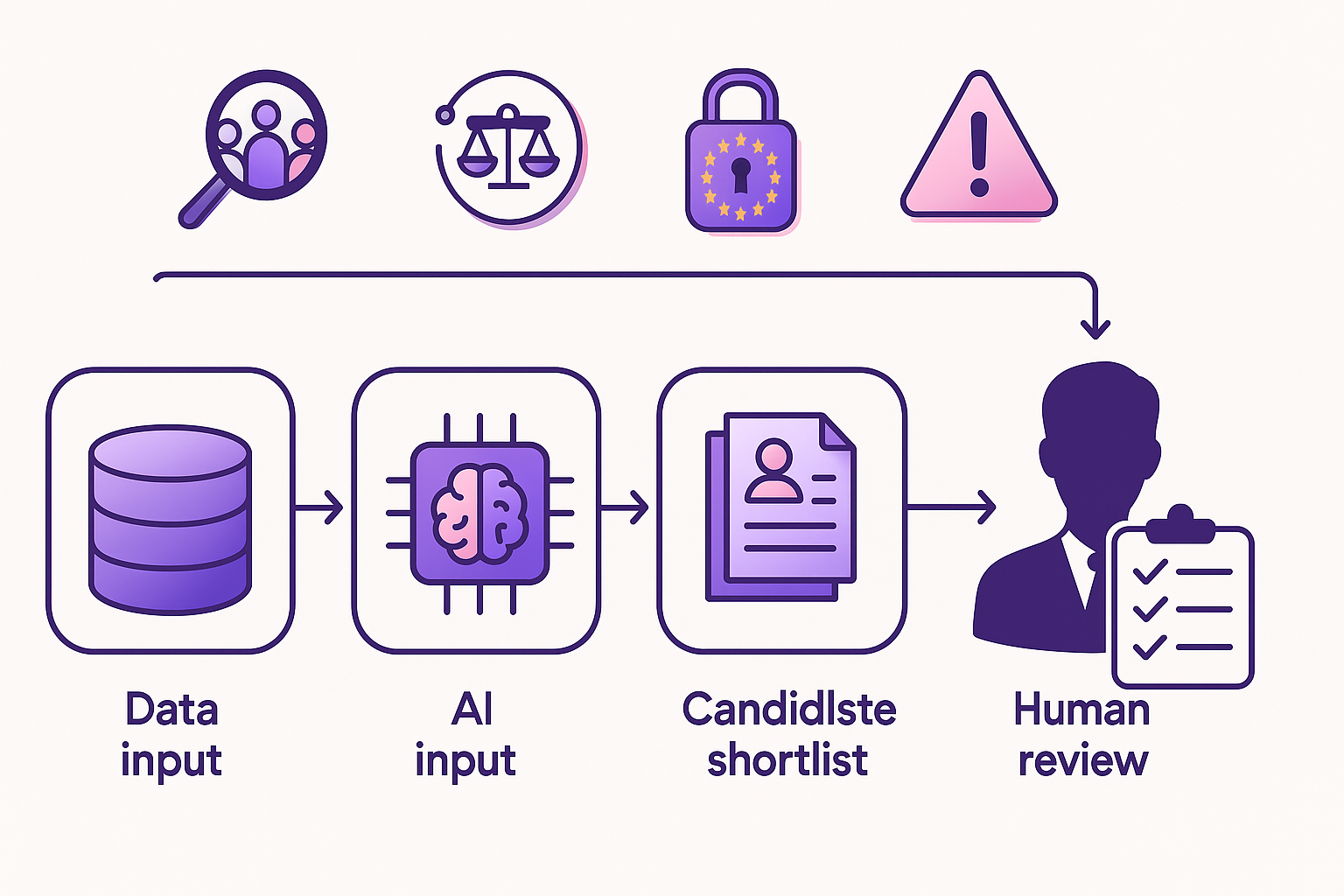
What compliance and bias risks come with AI recruiting?
AI offers efficiency gains, but also introduces governance and fairness risks that TA leaders must address proactively.
Responsible AI frameworks are becoming mandatory
By 2026, 60% of enterprise organizations will adopt responsible AI frameworks for HR technology, according to Gartner. Organizations that implement these frameworks report greater employee trust and improved experience.
AI systems require fairness and transparency
AI systems must ensure fairness and transparency to prevent bias. While AI can evaluate candidates based on objective criteria, algorithms trained on biased historical data may perpetuate existing inequities.
The risk of overlooking candidates
The top challenge organizations anticipate from using generative AI in hiring is the risk of overlooking candidates (56%). This concern underscores the importance of human oversight and regular bias audits.
Risk mitigation checklist
- Demand transparency from vendors on how AI models make decisions
- Implement regular bias audits across demographic groups
- Maintain human review for final hiring decisions
- Ensure compliance with GDPR, CCPA, and local AI regulations
- Train recruiters to identify and address AI-generated content in applications
Key takeaway: Responsible AI adoption requires governance frameworks, ongoing audits, and human oversight to ensure fairness and compliance.
Key takeaways for scaling your talent attraction in 2026
AI recruiting tools have moved from experimental to essential. For TA teams facing high-volume hiring demands, the right platform delivers speed, scale, and quality improvements that manual processes cannot match.
When evaluating options:
Prioritize integration depth over feature lists. Deep ATS connectivity saves hours weekly and reduces friction.
Model ROI on productivity gains rather than subscription costs. Tools that save 10 hours weekly per recruiter deliver significant returns.
Demand responsible AI safeguards. Bias audits and transparency will become table stakes as regulations tighten.
Consider quality of hire as the north star metric. Adway's Smart Scorecard automatically shortlists the best candidates using AI-generated screening questions and weighted scoring.
For enterprises seeking a proven, scalable social recruiting solution with transparent pricing and deep ATS integration, Adway offers a compelling path forward. The platform's recognition as a Fosway Core Leader for four consecutive years reflects consistent performance at enterprise scale.
Frequently Asked Questions
What are the benefits of using AI in high-volume hiring?
AI in high-volume hiring offers speed, scale, and quality. It automates resume screening, scheduling, and outreach, processes large applicant volumes, and matches candidates to roles effectively.
How does Adway's AI recruiting tool stand out for enterprises?
Adway's AI recruiting tool excels with its social recruiting capabilities, deep ATS integration, and AI-driven candidate screening, making it ideal for enterprises seeking seamless integration and high-quality hires.
What should TA leaders consider when evaluating AI recruiting software?
TA leaders should prioritize integration depth, productivity gains, and responsible AI safeguards. Deep ATS connectivity and bias audits are crucial for effective and fair recruitment processes.
How does Adway compare to HeyJobs for enterprise-scale recruiting?
Adway offers deeper ATS integration, analyst-validated performance, and a consumption-based pricing model, making it more suitable for enterprises compared to HeyJobs, which lacks API access.
What compliance risks are associated with AI recruiting?
AI recruiting poses risks like bias and lack of transparency. Organizations should implement responsible AI frameworks, conduct regular bias audits, and ensure human oversight to mitigate these risks.
Sources
- https://integrations.greenhouse.com/partners/adway-social-recruiting-technology
- https://adway.ai/
- https://adway.ai/solutions
- https://www.gartner.com/en/newsroom/press-releases/2024-11-25-gartner-hype-cycle-for-hr-technology-highlights-innovations-that-deliver-greater-flexibility
- https://www.linkedin.com/business/talent/blog/talent-acquisition/future-of-recruiting-2025
- https://www.gartner.com/en/human-resources/topics/artificial-intelligence-in-hr
- https://www.peoplebox.ai/blog/best-ai-recruiting-software/
- https://business.linkedin.com/talent-solutions/linkedin-hiring-integrations/ats-integrations
- https://juicebox.ai/blog/recruiting-software-comparison
- https://www.assessfirst.com/en/solutions/integrations-open-api
- https://www.performancereviewssoftware.com/software/ai-tools/recruiters/
- https://juicebox.ai/articles/9-best-ai-recruitment-platforms-for-2025-reviewed-and-compared
- https://www.selectsoftwarereviews.com/buyer-guide/ai-recruiting?__lai_s=0.26041666666666663&__lai_sr=25-29&__lai_sl=l&33db69b2_page=6&763fd0d8_page=5&7b35cd66_page=3&a2d55add_page=2
- https://www.gem.com/product/ats
- https://www.greenhouse.com/ai-recruiting
- https://www.recruitics.com/social-at-scale
- https://www.heyjobs.de/
- https://www.trustradius.com/products/heyjobs/reviews
- https://link.springer.com/article/10.1007/s44282-025-00246-w
- https://www.gartner.com/peer-community/oneminuteinsights/omi-applications-generative-ai-hiring-process-tpd