
Best AI Hiring Metrics for Talent Acquisition Teams in 2026
Discover essential AI hiring metrics for talent acquisition teams to enhance recruitment efficiency, quality, and cost-effectiveness in 2026.

Best AI Hiring Metrics for Talent Acquisition Teams in 2026
AI hiring metrics enable talent acquisition teams to track and optimize their recruiting processes through data-driven insights. Organizations using AI in recruiting hire 26% faster than those without AI support, with the global median time to hire at 38 days. These metrics transform recruiting from guesswork into measurable competitive advantage.
Key Facts
• Track core funnel metrics including time to hire, cost per hire, quality of hire, and source effectiveness to measure recruiting performance
• Companies need to monitor 73 applicants per role on average, with only 3 interviews and 1 offer made
• 60% of enterprise organizations will adopt responsible AI frameworks by 2026 to improve employee experience and trust
• Measure social recruiting effectiveness through view-to-apply rates, application drop-off rates, and time-to-apply metrics
• Build ROI models that connect KPIs to financial outcomes, translating metric improvements into measurable business value
• Choose analytics platforms that provide single-dashboard access, peer benchmarking, and seamless workflow integration
AI hiring metrics separate top-performing talent acquisition teams from those still guessing at what works. In 2026, data-driven recruiting is no longer optional. Organizations that master these indicators consistently out-compete peers in speed, quality, and cost efficiency.
This guide walks through the essential metrics every TA team should track, explains how AI sharpens each one, and shows what real results look like when you get measurement right.
Why Do AI Hiring Metrics Matter in 2026?
Recruitment metrics, or Key Performance Indicators (KPIs), indicate how effectively your organization hires. They reveal bottlenecks, highlight what works, and quantify improvement over time.
Yet technology alone is not enough. According to Gartner, by 2026 60% of enterprise organizations will adopt a responsible AI framework, achieving greater employee experience and trust. That framework depends on measuring the right things.
The gap between leaders and laggards is widening. Only 43% of organizations rate their TA stack as "good" or "excellent." Companies defined as Recruitment Technology Leaders adopt advanced tools at significantly higher rates than laggards and see better outcomes as a result.
AI-powered dashboards surface real-time insights, benchmark your funnel against peers, and predict where you will gain the most lift from automation. When used well, they shift TA from gut-feel to evidence-driven decision-making.
Key takeaway: Tracking the right AI hiring metrics transforms recruiting from a cost center into a measurable competitive advantage.
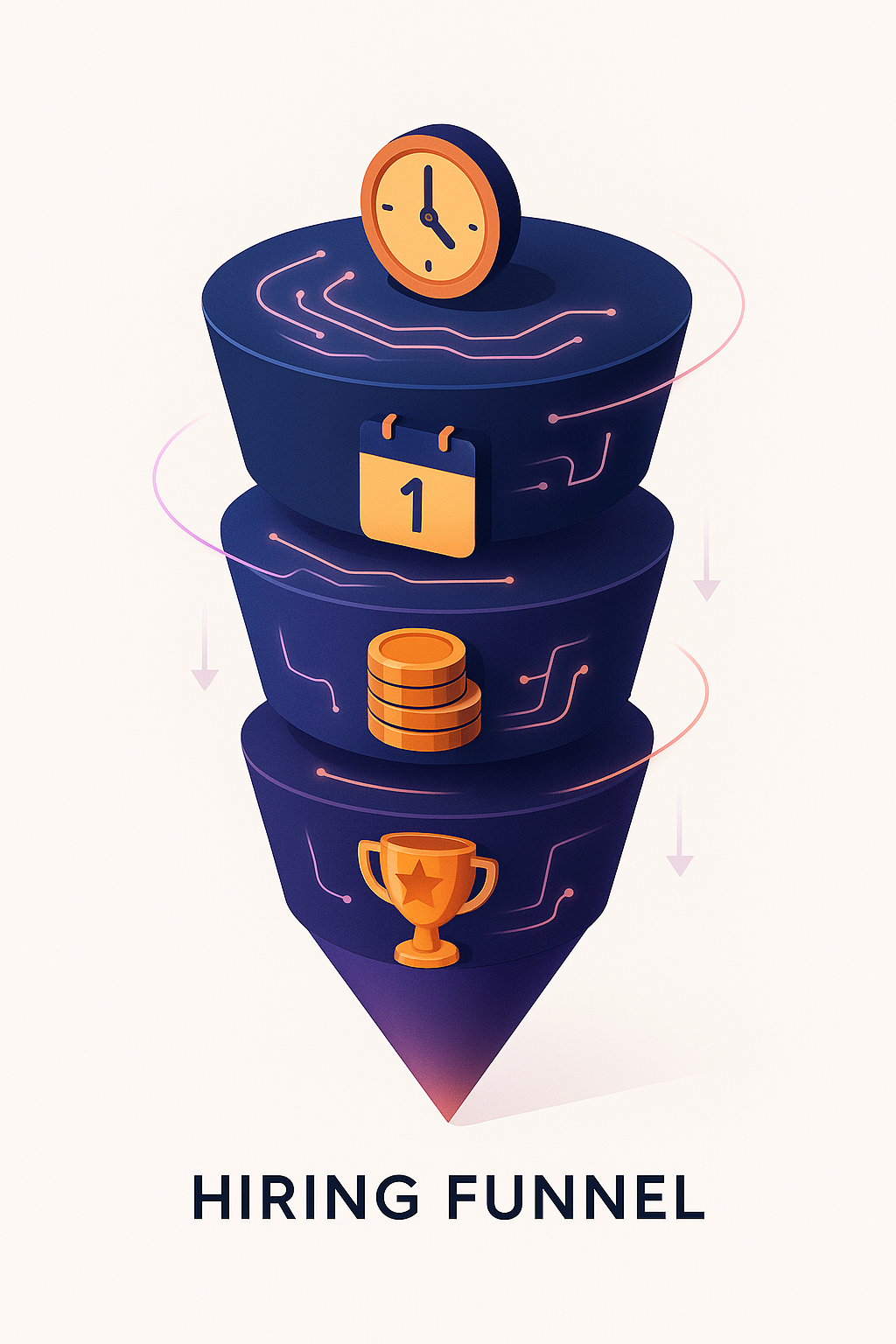
Which Core Funnel Metrics Should Every TA Team Track?
Four foundational KPIs anchor any effective AI hiring strategy:
| Metric | Definition | Why It Matters |
|---|---|---|
| Time to Fill | The amount of time needed to fill a position | Shows pipeline efficiency and resource requirements |
| Time to Hire | Days from first candidate touchpoint to accepted offer | Reveals hiring process efficiency |
| Cost per Hire | Average amount spent to make one hire | Tracks budget allocation and sourcing ROI |
| Quality of Hire | Value new hires bring over time | Connects recruiting to business performance |
Time to Fill and Time to Hire
The global median time to hire is 38 days. In 2026, both executive and nonexecutive time-to-fill hover around a month and a half, a notable convergence compared to previous years when executive roles took longer.
AI accelerates these timelines. Companies using AI in their recruiting processes hire 26% faster than those without.
Cost per Hire
Cost-per-hire for nonexecutive roles reached $1,200 in 2026, a 27% decrease since 2017. Executive hires tell a different story: costs hit $10,625, a 113% increase from 2017.
The formula remains straightforward:
CPH = (Internal Recruiting Costs + External Recruiting Costs) / Total Number of Hires
Quality of Hire
Quality of hire measures the value new hires bring to a company. Yet improving it is the top workforce priority for 45% of organizations in 2024.
Common indicators include performance ratings, ramp-up time, hiring manager satisfaction, and retention at key intervals. AI helps by scoring candidates against proven success patterns before they even interview.
Key takeaway: Track time, cost, and quality together. Optimizing one at the expense of others creates hidden costs.
How Do You Measure Social Recruiting & Candidate Experience?
Social channels now drive a significant share of candidate pipelines. Measuring their effectiveness requires metrics that go beyond vanity numbers.
The Metrics That Matter
- View-to-Apply Rate: The percentage of job seekers who viewed your job and applied
- Application Drop-off Rate: The percentage of candidates who started but failed to complete an application
- Time-to-Apply: Duration from starting an application to clicking submit
These numbers reveal friction. PwC Sweden discovered their process required 22 clicks to apply, resulting in drop-off rates of 70-80%. As their team noted:
"The clunky digital experience caused significant drop-off rates, sometimes as high as 70-80%!" (PwC Sweden Case Study)
With Adway's social recruiting technology, PwC streamlined its mobile flow, dramatically improving conversion.
Why Social Presence Matters
Research shows 86% of job seekers say a company's social media presence influences their decision to apply. But impressions and follower counts alone do not predict hiring success.
Instead, track:
- Candidate engagement leading to applications
- Application quality by source channel
- Conversion from first touchpoint to hire
Key takeaway: Application drop-off is often your biggest opportunity. Streamline mobile-first journeys to convert passive candidates into applicants.
How Can You Measure Sourcing Effectiveness for Passive & Active Talent?
Sourcing is the process of finding and engaging potential candidates, whether they are actively job hunting or not. Different candidate types require different metrics.
Passive Candidate Metrics
For passive candidates, the most important sourcing metrics include:
- Conversion rate from passive to active applicants
- Engagement rate on outreach
- Quality of passive candidates sourced
Personalization matters. Sequences with personalized messages achieve a 32.7% higher response rate compared to generic outreach.
Active Candidate Metrics
For active candidates, key metrics include:
- Application completion rate
- Time to hire
- Applicant satisfaction scores
Funnel-Level Sourcing Metrics
On average, there are 73 applicants per role, 3 applicants interviewed, and only 1 offer made. Understanding where candidates drop out of your funnel reveals optimization opportunities.
Key definitions:
- Sourcing Funnel: How many candidates move through each stage from initial contact to hire
- Time to Source: How long it takes to find and engage a qualified candidate
- Sourcing Conversion Rate: Candidates converted from one funnel stage to the next
- Sourcing Cost: Money spent on subscriptions, ads, events, and incentives
Key takeaway: Track passive and active funnels separately. They convert at different rates and require different investment levels.
What Happens When AI Supercharges Your KPIs?
Benchmarks are useful. Real-world results are more convincing.
Apoteket AB: From 88 to 31 Days
Swedish pharmacy chain Apoteket AB faced fragmented recruitment processes and an outdated ATS. Under the leadership of Carolina, Head of Talent Acquisition, the company deployed AI-driven social recruiting campaigns and centralized workflows.
The results:
- Applications per Vacancy: Increased from 5 to 23
- Time to Attract: Reduced from 32 to 12 days
- Time to Hire: Reduced from 88 to 31 days
That 65% reduction in time to hire came from improving processes and increasing hiring manager buy-in, not simply throwing technology at the problem.
Industry Benchmarks
Globally, companies using AI in recruiting hire 26% faster than those without AI support. Time savings is the most recognized benefit of AI, cited by 70% of respondents in HR technology surveys.
PwC Sweden: Full Funnel Visibility
"PwC now benefits from full source attribution and ROI visibility, tracking campaign effectiveness from first click to hire." (PwC Sweden Case Study)
This level of visibility transforms recruiting from a reactive function into a strategic business partner.
Key takeaway: AI impact compounds. Faster attraction leads to better candidate pools, which improves quality of hire, which reduces turnover costs.
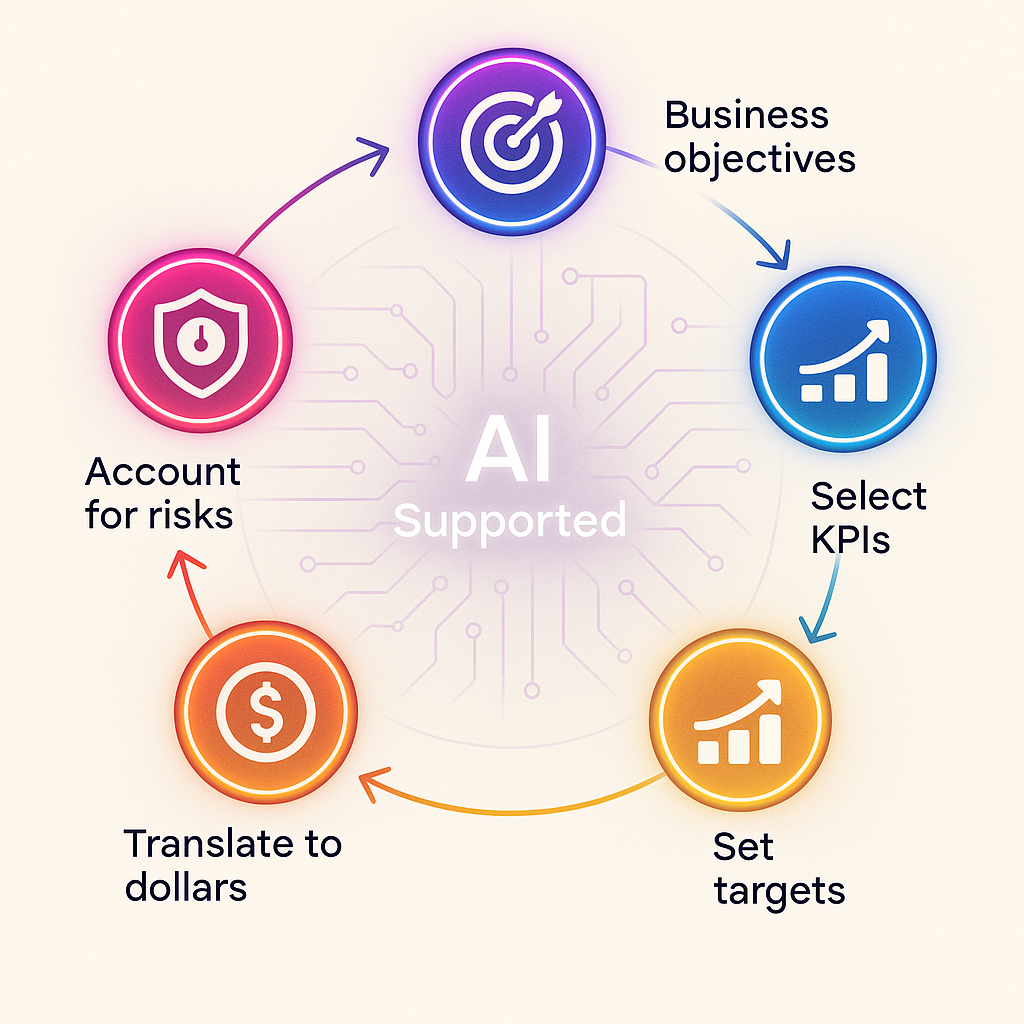
How Do You Build a Talent Acquisition ROI Model Around Metrics?
Proving AI value requires connecting KPIs to financial outcomes. Here is a step-by-step framework.
Step 1: Set Business Objectives
AI ROI typically falls into three categories: cost savings, revenue growth, and risk reduction. Define which objective matters most to your organization.
Step 2: Select Relevant KPIs
Pick 3-5 key performance indicators that prove impact on your primary goal. For TA, common choices include time to hire, cost per hire, quality of hire, and source effectiveness.
Step 3: Benchmark Current Performance
Measure where KPIs sit before AI comes into play. Without a baseline, improvement is impossible to quantify.
Step 4: Set Future Targets
Set targets for each KPI that reflect the improvements you expect to see. Be specific: "reduce time to hire by 20%" is more useful than "hire faster."
Step 5: Translate KPIs to Dollars
Convert KPI movement into actual dollars so the whole business understands the impact. For example, if reducing time to hire by 10 days saves $500 per role in recruiter time, and you fill 200 roles per year, that is $100,000 in savings.
Step 6: Account for Adoption Risks
Call out adoption risks such as training time and process changes. A recent MIT study found that 95% of AI investments produce no measurable return, often due to underestimating implementation challenges.
Real ROI Example
Enterprise AI spending surged eight-fold in 2024, yet many organizations struggle to demonstrate value. SAP Concur provides a counterexample: within six months of deploying AI-powered self-service, they achieved a 30% drop in support case volume, translating to €8 million in annual cost avoidance.
The same principle applies to recruiting. McKinsey research shows AI could one day automate tasks that currently occupy 60 to 70 percent of employees' time. The organizations capturing that value are those measuring outcomes, not just activity.
Key takeaway: Lead with Net Present Value (NPV) when presenting AI business cases. It is the clearest measure of value created and the exact information CFOs use to approve projects.
Which Dashboards & Platforms Best Track AI Hiring Numbers?
The TA technology market is evolving rapidly. Here is how to evaluate options.
What to Look For
Effective recruiting analytics platforms should:
- Provide access to metrics that matter in a single platform
- Deliver contextualized insights and peer benchmarking
- Allow segmentation by geography, role, industry, and organization size
- Enable easy download and sharing of data
Market Landscape
The 2026 Gartner Magic Quadrant for Talent Acquisition Suites analyzed 22 TA vendors through buyer feedback and vendor briefings. Leaders were recognized for vision and execution across key use cases.
Oracle was named a Leader and ranked highest for Extended AI Innovations Use Case. Their AI-powered time-to-hire predictions help hiring teams estimate how long it will take to fill positions.
Greenhouse was named a Visionary, emphasizing how TA technology impacts enterprise business outcomes.
Where Gaps Exist
Many platforms excel at applicant tracking but lack sophisticated social recruiting automation. Others offer strong analytics but limited ATS integration.
For teams prioritizing passive candidate engagement and social-first recruitment, platforms that combine programmatic advertising with ATS integration and transparent ROI tracking fill an important gap. Adway, recognized as a Core Leader in the 2026 Fosway 9-Grid for Talent Attraction & Engagement, offers this combination with consumption-based pricing and seamless workflow integration.
Key takeaway: Evaluate platforms on integration depth, not just feature lists. The best analytics are useless if data does not flow into your existing workflows.
Avoiding Vanity Metrics & Other Common Traps
Not all metrics create value. Some actively mislead.
The Vanity Metric Problem
Vanity metrics often mask what truly drives recruitment outcomes, giving a false sense of success while actual hiring challenges persist.
A post with 50,000 impressions sounds successful. But if none of those viewers became applicants, what did that impression count actually achieve?
Common Traps to Avoid
Measuring activity instead of outcomes: Tracking applications received without tracking application quality
Ignoring the full funnel: Celebrating low cost per hire while missing that 18% of new hires leave during probation (overall hiring success stands at just 46% in Europe)
Under-measuring quality of hire: The percentage of organizations using quality-of-hire metrics dipped to 20% in 2026, down from 27% in 2022
Over-indexing on speed: Less than half of talent leaders currently measure recruitment effectiveness at all, let alone holistically
Better Alternatives
Instead of vanity metrics, focus on:
- Source-to-hire conversion by channel
- Candidate quality indicators at each funnel stage
- Retention rates at 90-day, one-year, and two-year marks
- Hiring manager satisfaction with candidate quality
Key takeaway: The most dangerous metric is the one that looks good in a slide deck but does not connect to hiring outcomes.
Key Takeaways for Data-Driven Hiring
Mastering AI hiring metrics requires a systematic approach:
Start with core funnel metrics: Time to hire, cost per hire, quality of hire, and source effectiveness form the foundation
Measure social and candidate experience separately: Application drop-off and mobile conversion reveal hidden friction
Track passive and active candidates differently: They convert at different rates and require different investments
Connect KPIs to financial outcomes: Build ROI models that translate metric improvements into dollars saved or earned
Choose platforms that integrate: The best analytics are useless without workflow connectivity
Avoid vanity metrics: Focus on outcomes, not activity
Organizations that get this right see dramatic results. Apoteket cut time to hire from 88 to 31 days. PwC Sweden gained full source attribution from first click to hire. These outcomes are achievable for any team willing to measure what matters.
Adway, recognized as a Core Leader in the 2026 Fosway 9-Grid for Talent Acquisition, helps mid-market and enterprise teams implement this approach with AI-driven social recruiting, transparent consumption-based pricing, and dashboards that track ROI from campaign to hire.
The data is clear: talent teams that master AI hiring metrics out-compete peers. The question is no longer whether to measure, but how quickly you can start.
Frequently Asked Questions
What are the core AI hiring metrics every TA team should track?
The core AI hiring metrics include Time to Fill, Time to Hire, Cost per Hire, and Quality of Hire. These metrics help measure pipeline efficiency, hiring process effectiveness, budget allocation, and the value new hires bring to the organization.
How does AI improve recruitment metrics?
AI enhances recruitment metrics by providing real-time insights, benchmarking against peers, and predicting where automation can offer the most benefit. This shifts talent acquisition from intuition-based to evidence-driven decision-making, improving speed, quality, and cost efficiency.
Why is measuring social recruiting important?
Measuring social recruiting is crucial as social channels significantly contribute to candidate pipelines. Metrics like View-to-Apply Rate, Application Drop-off Rate, and Time-to-Apply reveal friction points and help optimize the candidate experience, especially in mobile-first application journeys.
How can AI-driven platforms like Adway benefit talent acquisition teams?
AI-driven platforms like Adway offer programmatic job advertising, seamless ATS integration, and transparent ROI tracking. These features help talent acquisition teams engage passive candidates, streamline recruitment processes, and measure campaign effectiveness from first click to hire.
What are the risks of focusing on vanity metrics in recruitment?
Focusing on vanity metrics, such as impressions or follower counts, can mislead recruitment efforts by masking true performance. Instead, teams should focus on metrics that directly impact hiring outcomes, like source-to-hire conversion and candidate quality indicators.
Sources
- https://ta.smartrecruiters.com/rs/664-NIC-529/images/Recruitment-Benchmarks-2025-Report.pdf?version=0
- https://www.gartner.com/en/newsroom/press-releases/2024-11-25-gartner-hype-cycle-for-hr-technology-highlights-innovations-that-deliver-greater-flexibility
- https://go.workable.com/hubfs/recruiting-metrics-ebook.pdf
- https://eightfold.ai/learn/hr-coms-future-of-recruitment-technologies-2025-26/
- https://www.pageuppeople.com/resource/recruitment-metrics-the-key-to-your-talent-acquisition-strategy/
- https://www.shrm.org
- https://www.pageuppeople.com/resource/recruitment-metrics-glossary/
- https://www.peoplescout.com/insights/social-media-metrics-for-recruitment/
- https://www.linkedin.com/advice/1/what-most-important-sourcing-metrics-finding-passive-mpfkf
- https://pages.analyticssearch.com/candidate-engagement-guide
- https://adway.ai/insights/ai-driven-talent-acquisition-strategy-apoteket-case-study
- https://you.com/articles/an-enterprise-guide-to-ai-roi-measurement
- https://menlo.com
- https://www.mckinsey.com
- https://www.gartner.com/en/human-resources/insights/hr-metrics
- https://www.idc.com
- https://www.oracle.com
- https://www.greenhouse.com
- https://www.fosway.com
- https://www.mckinsey.com/~/media/mckinsey/business%20functions/people%20and%20organizational%20performance/our%20insights/hr%20monitor%202025/hr-monitor-2025.pdf