
AI social recruiting platform vs job boards: 54% lower cost-per-hire
Discover how AI social recruiting platforms reduce cost-per-hire by 54% compared to job boards, enhancing reach and candidate quality.

AI social recruiting platform vs job boards: 54% lower cost-per-hire
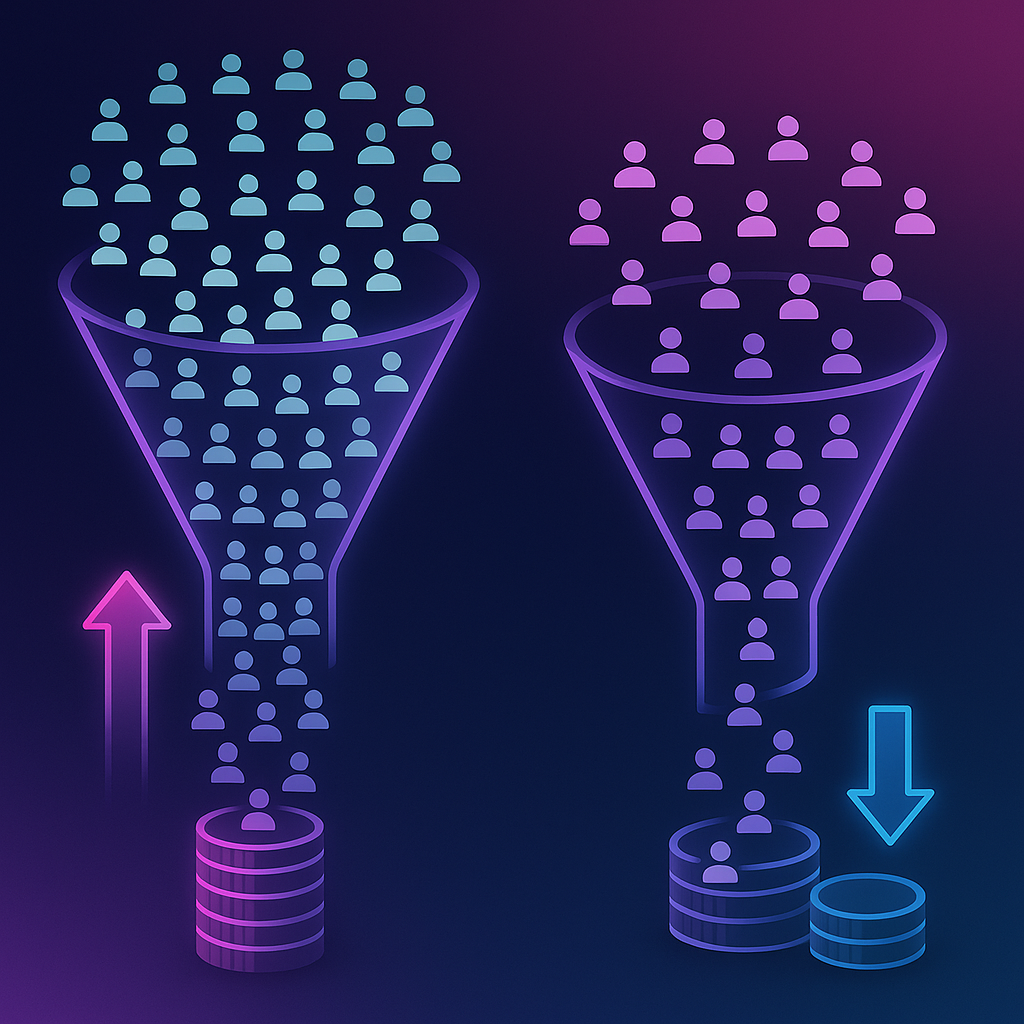
AI social recruiting platforms deliver 54% lower cost-per-application compared to traditional job boards by leveraging programmatic advertising across social channels. With 4.8 billion active social media users spending 2.5 hours daily on platforms, AI-driven campaigns reach passive candidates that job boards miss while improving quality of hire by 40% and reducing time-to-hire by 59%.
Key Facts
• Cost savings: Social recruiting delivers 54-68% lower cost-per-application versus job boards, with some customers achieving 24× more quality applications
• Reach advantage: AI platforms tap into 4.8 billion social users, while 73% of millennials found their last job through social media ads
• Speed improvements: Time-to-hire drops by 59% on average, with specific cases showing reduction from 88 to 31 days
• Quality gains: Organizations report 33-40% improvement in quality of hire metrics when using AI-powered recruitment
• Conversion rates: Job boards generate 60% of applications but only 37% of hires, showing poor conversion efficiency
• Enterprise adoption: 84% of organizations now use social media for recruiting, with 74% of HR professionals endorsing AI benefits over risks
Talent acquisition budgets are under pressure, and TA teams need channels that deliver better candidates without blowing the budget. An AI social recruiting platform now drives a 54% reduction in cost per application compared with traditional job boards, according to Adway customer data. This post breaks down why job boards are losing ground, how programmatic social media advertising reaches untapped talent, and what the numbers say about cost, speed, and quality gains.
Why is AI social recruiting outpacing job boards?
Job boards once dominated recruiting, but the talent landscape has shifted. Manual targeting simply cannot keep up with the speed or precision of modern social recruiting technology. Meanwhile, 4.8 billion active social media users spend an average of 2.5 hours per day scrolling feeds where AI-powered campaigns can intercept them.
The reach gap is stark. Traditional boards serve active job seekers, yet the majority of qualified candidates are passive. "73% of millennials have found their last job through social media ads," notes a 2025 recruitment spend analysis. Social recruiting engages these passive candidates before competitors even know they exist.
Key takeaway: AI social recruiting platforms combine global reach with algorithmic precision, enabling TA teams to target pre-engaged talent that job boards cannot surface.
What hidden costs make job boards less efficient in 2026?
Job boards look affordable on paper, but the true cost of hire tells a different story.
| Metric | Job Boards | Social Recruiting |
|---|---|---|
| Share of applications | 60% | Varies by campaign |
| Share of hires | 37% | Higher conversion |
| Referral-to-hire multiplier | 1× baseline | Up to 11× for referrals |
CareerPlug data shows that job boards produced 60% of all applications but only 37% of hires. In contrast, referrals and career pages yield candidates who convert at far higher rates. The implication is clear: volume does not equal value.
Budget visibility is another concern. Only 22% of recruiting executives have visibility into their hiring needs, while 78% face stagnant or shrinking budgets. Pouring spend into low-conversion channels only compounds the problem.
Time-to-fill also inflates hidden costs. NXTThing RPO reports that the average time to fill is 47.5 days across company sizes. Appcast benchmarks peg cost-per-hire at roughly $851, a figure that climbs when vacancies drag on and hiring managers wait.
Key takeaway: Job board volume masks poor conversion and opaque costs, leaving TA teams with inflated spend and underwhelming quality of hire.
How does an AI social recruiting platform reach talent job boards miss?
"Programmatic social media job advertising has transformed from a niche recruitment tactic into a strategic imperative for talent acquisition teams." (Adway Insights)
An AI social recruiting platform automates ad placement, targeting, and optimization across Facebook, Instagram, LinkedIn, TikTok, Snapchat, and more. Instead of static listings, campaigns analyze real-time behavioral data to serve the right message to the right candidate at the right moment.
Core components include:
- Programmatic job advertising: Algorithms determine optimal platforms, timing, and bid strategies.
- ATS integration: Leads flow directly into existing applicant tracking systems. Adway, for example, connects with any ATS and CRM through plug-and-play connectors.
- Mobile-first candidate journeys: Applications start and finish on mobile, meeting candidates where they spend time.
Gartner research confirms momentum: 74% of HR professionals agree the benefits of generative AI in hiring outweigh the risks, and most organizations plan to increase investment over the next 12 months.
Reducing bias, expanding diversity
AI-powered platforms also address fairness. Bias-free algorithms analyze skills and behaviors rather than proxies like name or location. AI ALPI reports that AI-enabled recruitment processes make organizations 2.3 times more likely to improve quality of hire and 3.1 times more likely to mitigate bias.
PwC Sweden illustrates the point: "Bias reduction was another major focus. PwC uses AI to ensure inclusive, bias-free job ads and anonymised assessments," according to the PwC Sweden case study.
What do the numbers say about cost, speed and quality gains?
Hard data separates hype from results. Across independent studies and customer benchmarks, AI social recruiting consistently outperforms job boards on the metrics that matter.
- Time-to-hire: Adway customers report a 59% reduction in time-to-hire.
- Quality of hire: Organizations implementing AI-driven recruitment solutions see a 40% improvement in candidate quality metrics.
- Cost-per-hire: AI-driven recruitment reduces cost-per-hire by 28–32% compared with legacy channels.
- Sourced candidate advantage: Gem benchmarks show that sourced candidates are 8× more likely to be hired than applicants from boards.
Why cost-per-hire drops 54%
The 54% figure comes from Adway data, which tracks cost per application across thousands of campaigns. CareerArc echoes this finding, reporting that social recruiting CPCs cost 68% less than job ads.
Lower click costs compound with higher conversion rates. When the right candidates see the right message, fewer impressions convert into more quality applications, driving down overall cost-per-hire.
Real-world results from Adway customers
Numbers gain meaning through context. Below are three enterprise examples that illustrate the shift from job boards to AI social recruiting.
Ocab (property damage restoration, Sweden)
Ocab struggled to fill sanitation technician roles. Traditional job boards delivered just five applications per vacancy. After adopting Adway, "Applications for sanitation technician roles jumped from 5 to 120+," and the company recorded 24× more quality applications. Quality of hire improved by 33%, and time-to-attract dropped from 34 days to 12.
Apoteket AB (pharmacy retail, Sweden)
Apoteket faced an outdated ATS and fragmented processes. By centralizing recruitment marketing and leveraging targeted social ads, the team increased applications per vacancy from 5 to 23 and cut time-to-hire from 88 days to 31.
PwC Sweden (professional services)
PwC's legacy application flow required 22 clicks, causing drop-off rates as high as 70–80%. "With the help of Adway's Social Recruiting Technology, PwC reduced the application from 22 clicks to just 5," states the PwC case study. The firm now tracks full source attribution and ROI from first click to hire.
Evaluating AI recruiting platforms (and where job boards still fit)
Not every role demands programmatic social advertising. High-volume hourly positions, niche specialist searches, and executive hires each call for different channel mixes.
When job boards still add value:
- Active job seekers in saturated markets
- Compliance-driven postings that require broad visibility
- Legacy integrations that feed existing ATS workflows
When AI social recruiting excels:
- Passive candidate engagement
- Hard-to-fill roles where traditional sourcing fails
- Employer branding campaigns that build long-term talent pools
Platform selection should weigh AI capabilities, ATS integration, and skills-based hiring support. G2 reviewers note that Recruit CRM & ATS excels in candidate evaluations and applicant data management, scoring 9.2 and 9.5, while HiredScore AI for Recruiting earns a 4.8 out of 5 rating from enterprise users. Fosway Group's 2025 9-Grid positions multiple vendors as Core Leaders, reflecting market maturation.
Key takeaway: Blend channels strategically. Use job boards for compliance and active seekers; deploy AI social recruiting for passive talent and quality of hire.

Roll-out checklist: from pilot to enterprise scale
Moving from job boards to AI social recruiting requires deliberate steps. Use the checklist below to guide implementation.
- Audit current spend and conversion. Map cost-per-hire and source-of-hire data to identify underperforming channels.
- Select a platform with ATS integration. Confirm that leads flow into your existing system without manual uploads. Adway connects with any ATS and CRM.
- Define pilot roles. Start with hard-to-fill positions where job boards have failed.
- Set success metrics. Track time-to-hire, cost-per-application, and quality of hire from day one.
- Train recruiters on AI-assisted workflows. LinkedIn research shows that AI saves recruiters about 20% of their work week, freeing time for relationship-building.
- Scale based on data. Expand to additional roles and regions once pilot metrics prove ROI.
- Iterate with compliance in mind. Gartner notes that 26% of HR leaders are already underway with an AI-first operating model; ensure governance keeps pace.
Key takeaways: social recruiting wins on reach, quality and cost
The evidence is clear. AI social recruiting platforms deliver:
- Broader reach: 4.8 billion social users versus shrinking job board audiences
- Higher quality: 33–40% improvement in quality of hire metrics
- Lower cost: 54–68% reduction in cost per application
Adway has earned Core Leader status in the 2025 Fosway 9-Grid for Talent Acquisition for the fourth consecutive year, validating its enterprise-scale performance. Customers like Ocab report 24× more quality applications and 33% more quality hires per vacancy.
If your TA team is ready to move beyond job boards and unlock passive talent at lower cost, explore how Adway's AI-powered platform can transform your recruitment marketing. Visit adway.ai/predict to model your potential ROI.
Frequently Asked Questions
What is the main advantage of AI social recruiting over job boards?
AI social recruiting platforms offer a 54% reduction in cost-per-hire by targeting passive candidates through social media, which job boards often miss.
How do AI social recruiting platforms reduce hiring costs?
These platforms use programmatic advertising to optimize ad placement and targeting, reducing cost-per-hire by 28-32% compared to traditional methods.
Why are job boards considered less efficient in 2026?
Job boards often have hidden costs and lower conversion rates, leading to inflated spending and less effective hiring outcomes compared to AI-driven solutions.
How does Adway integrate with existing hiring systems?
Adway seamlessly connects with any ATS and CRM through plug-and-play connectors, ensuring smooth integration into existing recruitment workflows.
What impact does AI social recruiting have on time-to-hire?
Adway customers report a 59% reduction in time-to-hire, as AI-driven platforms streamline the recruitment process and improve candidate engagement.
Sources
- https://adway.ai/
- https://content.adway.ai/insights/adway-ai-recruitment-social-media-2025
- https://adway.ai/insights
- https://adway.ai/why-use-social-recruiting-technology
- https://www.careerplug.com/wp-content/uploads/2024/04/2024-Recruiting-Metrics-Report-1.pdf
- https://www.gartner.com/en/human-resources/topics/recruiting-strategy
- https://nxtthingrpo.com/2023/10/recruiting-funnel-metrics/
- https://www.appcast.io/the-2025-recruitment-marketing-benchmark-report-is-live/
- https://adway.ai/insights/top-programmatic-social-media-job-advertising-platforms-for-2025
- https://adway.ai/integrations
- https://www.gartner.com/peer-community/oneminuteinsights/omi-applications-generative-ai-hiring-process-tpd
- https://www.aialpi.com/insights/the-roi-of-ai-in-recruitment-beyond-cost-savings
- https://www.gem.com/resource/recruiting-benchmarks
- https://social.careerarc.com/2022-social-recruiting-cpc-roi-benchmark-report/
- https://adway.ai/insights/ai-driven-talent-acquisition-strategy-apoteket-case-study
- https://www.g2.com/compare/beamery-vs-recruit-crm-ats
- https://www.g2.com/compare/workday-hiredscore-ai-for-recruiting-vs-seekout
- https://business.linkedin.com/talent-solutions/resources/future-of-recruiting
- https://www.gartner.com/en/human-resources/topics/artificial-intelligence-in-hr
- https://adway.ai/predict